Provenance
John Gibbons [1777-1851], Corbyn's Hall, Staffordshire, and London;[1] by inheritance to his son, the Reverend Benjamin Gibbons [1824-1894], Waresley House and Waresley Court, Worcestershire, and London;[2] (sale, Christie, Manson & Woods, London, 26 May 1894, no. 6); purchased by (Thos. Agnew and Sons, Ltd., London) for Sir Charles Clow Tennant, 1st bt. [1823-1906], The Glen, near Innerleithen, Peeblesshire, Scotland; by descent in the family to his great-grandson, Colin Christopher Paget Tennant, 3rd baron Glenconner [1926-2010], The Glen;[3] sold November 1975 through (Thos. Agnew and Sons, Ltd., London) to Mrs. Ruth Carter Stevenson [1923-2013], Fort Worth; bequest to NGA.[4]
[1] Gibbons was an ironmaster and art patron from Edgbaston near Birmingham, and he had a gallery specially built for his collection at his London home, 16 Hanover Terrace, Regent's Park. See: Kathryn Moore Heleniak, "John Gibbons and William Mulready: The Relationship between a Patron and a Painter," _The Burlington Magazine_ 124, no. 948 (March 1982): 136-141.
[2] Rev. Gibbons lent the painting to the 1890 Winter Exhibition at the Royal Academy of Arts in London.
[3] The 3rd baron's father, Christopher Grey Tennant, 2nd baron Glenconner (1899-1983), was still living when the painting was sold to NGA's donor, and the 2nd baron would have been the Lord Glenconner who lent the painting to a 1951 exhibition at the Royal Academy of Arts in London. However, documents in NGA curatorial files given by the donor all name Colin Tennant as the painting's owner.
[4] At the time of her 1975 purchase of the painting, the NGA donor was married to J. Lee Johnson III. She married Johnson in 1946 and they were divorced in 1978; she married John "Jack" Stevenson in 1983. In 1991 Mrs. Stevenson promised the painting as a bequest to the NGA.
Accession Number
2016.115.1
Medium
oil on canvas
Dimensions
overall: 31.7 × 50.8 cm (12 1/2 × 20 in.)
Classification
Painting
Credit Line
Gift of Ruth Carter Stevenson in Honor of the Fiftieth Anniversary of the National Gallery of Art
Tags
Painting Neoclassical & Romantic (1751–1850) Oil Painting Canvas British
Background & Context
Background Story
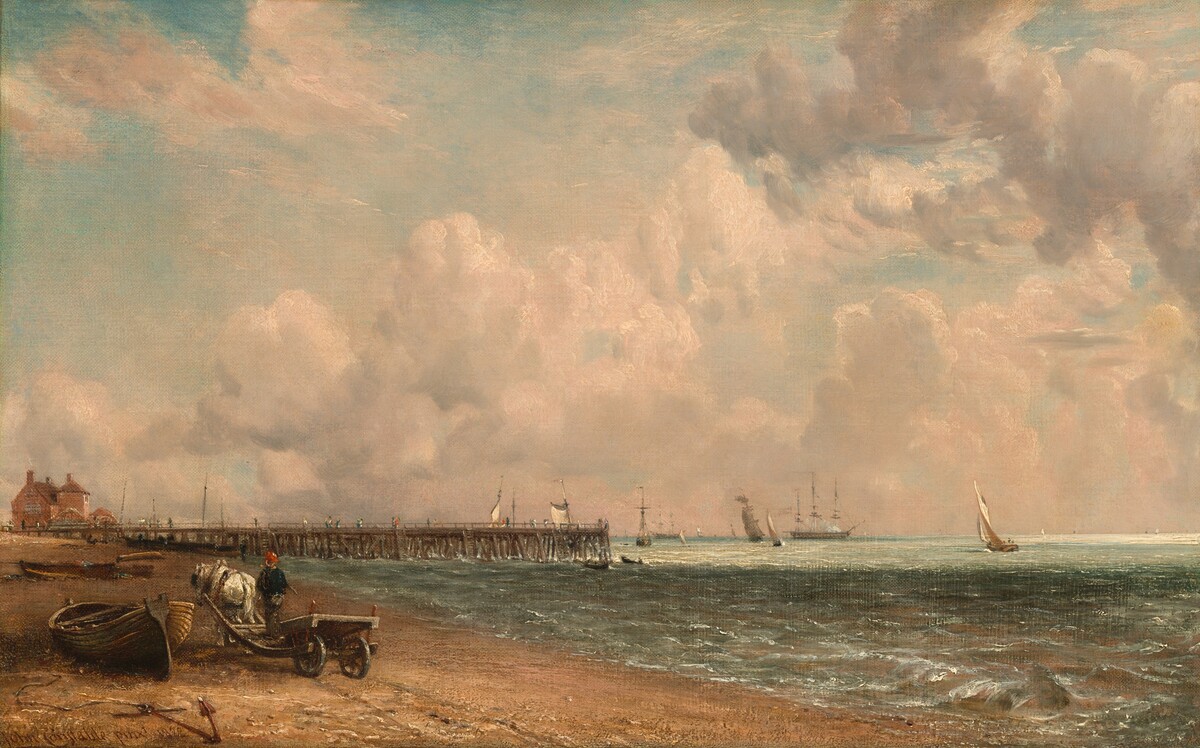
Yarmouth Jetty depicts the coast of Norfolk where Constable spent time with his wife's family, the Fishers. The painting shows a wooden jetty extending into a restless sea under a heavy, cloud-filled sky. Constable was a landlocked painter by preference — his heart was in the Stour Valley — but his coastal scenes reveal the same atmospheric sensitivity he brought to inland landscapes. The sea here is not Turner's tempestuous ocean but a working coastline, where fishing boats and jetties structure the view just as locks and weirs structure his river scenes.
Cultural Impact
Norfolk's flat, open coastline presented Constable with a different compositional challenge from the intimate hedgerow landscapes he knew best. Here he compensates with sky — the vast East Anglian sky becomes the dominant element, with the jetty and figures providing necessary anchors. This approach to sky as subject would influence the Hague School and, through them, early modernist landscape painting.
Why It Matters
Yarmouth Jetty shows Constable expanding his range without abandoning his principles. The sky remains the key, and the human elements provide scale rather than narrative.