Provenance
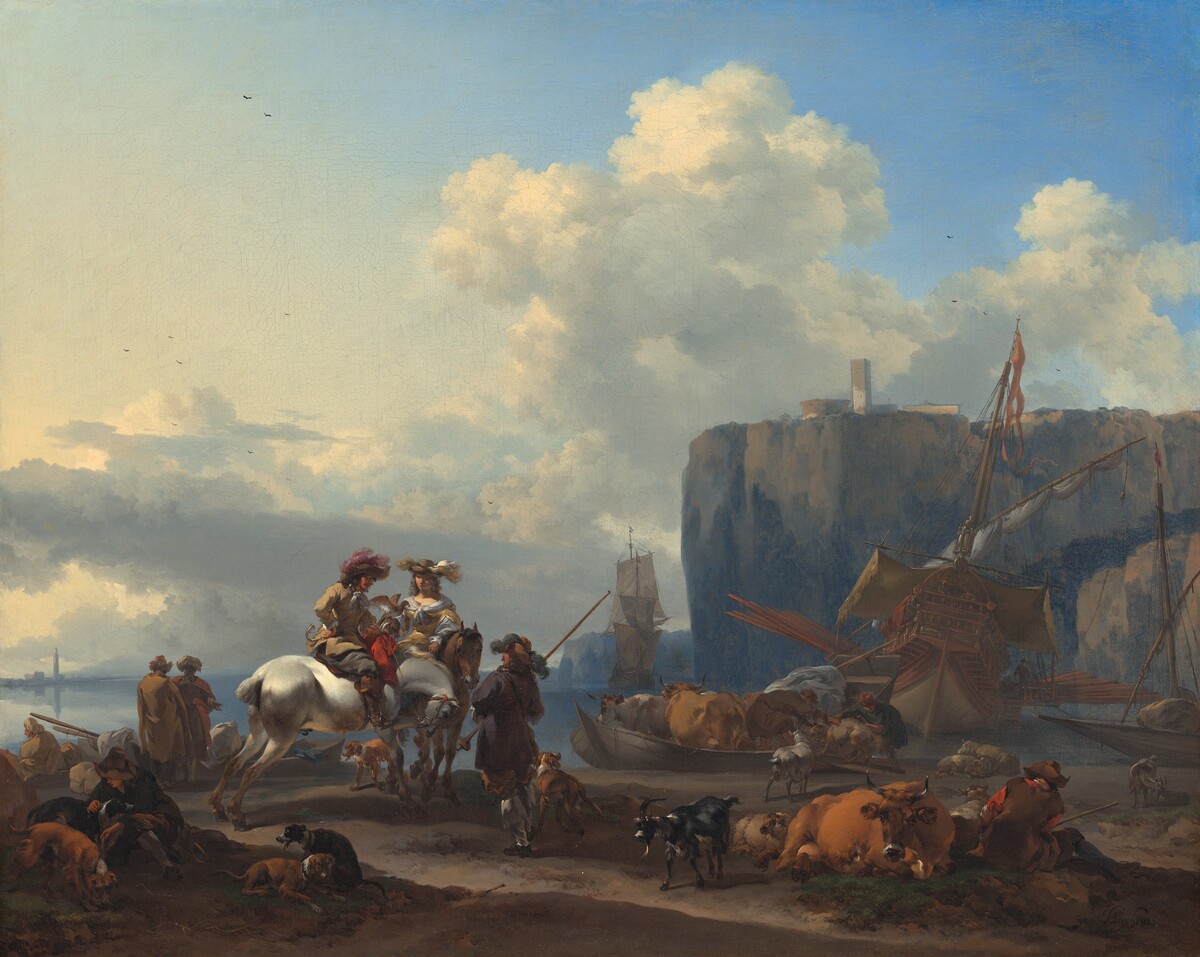
Johan van Lanschot, Leiden, by 1753;[1] by inheritance to his son-in-law, Pieter Cornelis, baron van Leyden [1717-1788, known during his lifetime as the Heer van Leyden van Vlaardingen], Leiden;[2] by inheritance with the paintings in his collection to his son, Diederik van Leyden, [1744-1810/1811], Leiden and Amsterdam;[3] sold, with the rest of his father's painting collection, for 100,000 florins to a consortium formed by L.B. Coclers, Alexander Joseph Paillet, and A. de Lespinasse de Langeac;[4] (sale of the van Leyden painting collection, A. Paillet and H. Delaroche, Paris, 5-8 November 1804, 1st day, no. 8);[5] H. Delaroche. John Parke, Esq., London; (his sale, Peter Coxe, London, 8-9 May 1812, no. 37). (John Smith, London); sold to John Webb, Esq., London. Chevalier Sébastien Érard [1752-1831], Château de la Muette, near the Bois de Boulogne, Paris; (his estate sale, at his residence by Lacoste and Coutelier, 7-14 August 1832 [originally scheduled for 23 April and days following], no. 62);[6] purchased by Alexis-Nicolas Pérignon, Paris, for Jonkheer Johan Steengracht van Oostcapelle [1782-1846], The Hague;[7] by inheritance to his son, Hendrik Steengracht van Oosterland [1808-1875], The Hague; by inheritance to his nephew, Hendricus Adolphus Steengracht van Duivenvoorde [1836-1912], The Hague; (his estate sale, Galerie Georges Petit, Paris, 9 June 1913, no. 4); Mr. Boyer.[8] by inheritance from the collector’s grandfather to private collection; (sale, Adar Picard Tajan, Paris, 9 April 1990, no. 82); Robert H. and Clarice Smith, Washington; gift (partial and promised) 1990 to NGA; gift completed 1996..
[1] Van Lanschot is identified by the inscription on an engraving of the painting executed by Abraham Delfos in 1753. Given the family connection between Van Lanschot and Van Leyden, it is probable that the painting engraved was the Gallery’s, although, as Egbert Haverkamp-Begemann has noted, it is possible that one of the copies after _View of an Italian Port_ was the model for the print.
[2] See the description of Sale F-80, by Benjamin Peronnet, in The Getty Provenance Index© Databases, accessed 17 February 2012, and J.W. Niemeijer,“Baron van Leyden, Founder of the Amsterdam Print Collection,” trans. Patricia Wardle, Apollo (June 1983): 461-468. As Niemeijer explains, in Van Leyden’s own day the title of baron was not actually used; when alive he was known as the Heer Van Leyden van Vlaardingen. He is given the title of baron in later publications, a title that was indeed his, as an ancestor was created a baron of the Holy Roman Empire in 1548.
[3] Niemeijer 1983, 468. While his son inherited the paintings, Van Leyden’s large and important print collection was bequeathed to his grandson, after whose death in 1789 it became the property of the young man’s mother. Sold in 1806 to Louis Napoleon, it was first housed in The Hague, then Paris, and was eventually returned in 1816 to Amsterdam, where it formed the nucleus of the print collection at the Rijksmuseum.
[4] This information is given in the catalogue for sale 6323 at Christie’s, London, 7 July 2000, as part of the provenance for lot 17 (Jan Both, _An Italianate evening landscape with a muleteer and goatherds on a wooded path, a river and mountains beyond_, now NGA 2000.91.1, _An Italianate Evening Landscape_), but no source is cited.
[5] The sale was originally scheduled for 5 July 1804, and rescheduled for 10 September 1804 (the date printed on the sale catalogue), before finally taking place in November.
[6] The catalogue incorrectly described the painting as being on panel.
[7] The information about Parke’s ownership through that of Steengracht is found in the 1913 sale catalogue.
[8] An annotated copy of the auction catalogue housed at the NGA library notes that Boyer purchased the picture for Fr 7,900.
Accession Number
1990.62.1
Medium
oil on canvas
Dimensions
overall: 48 x 59.5 cm (18 7/8 x 23 7/16 in.) | framed: 68.6 x 80 x 5.3 cm (27 x 31 1/2 x 2 1/16 in.)
Classification
Painting
Credit Line
Gift of Robert H. and Clarice Smith, in Honor of the 50th Anniversary of the National Gallery of Art