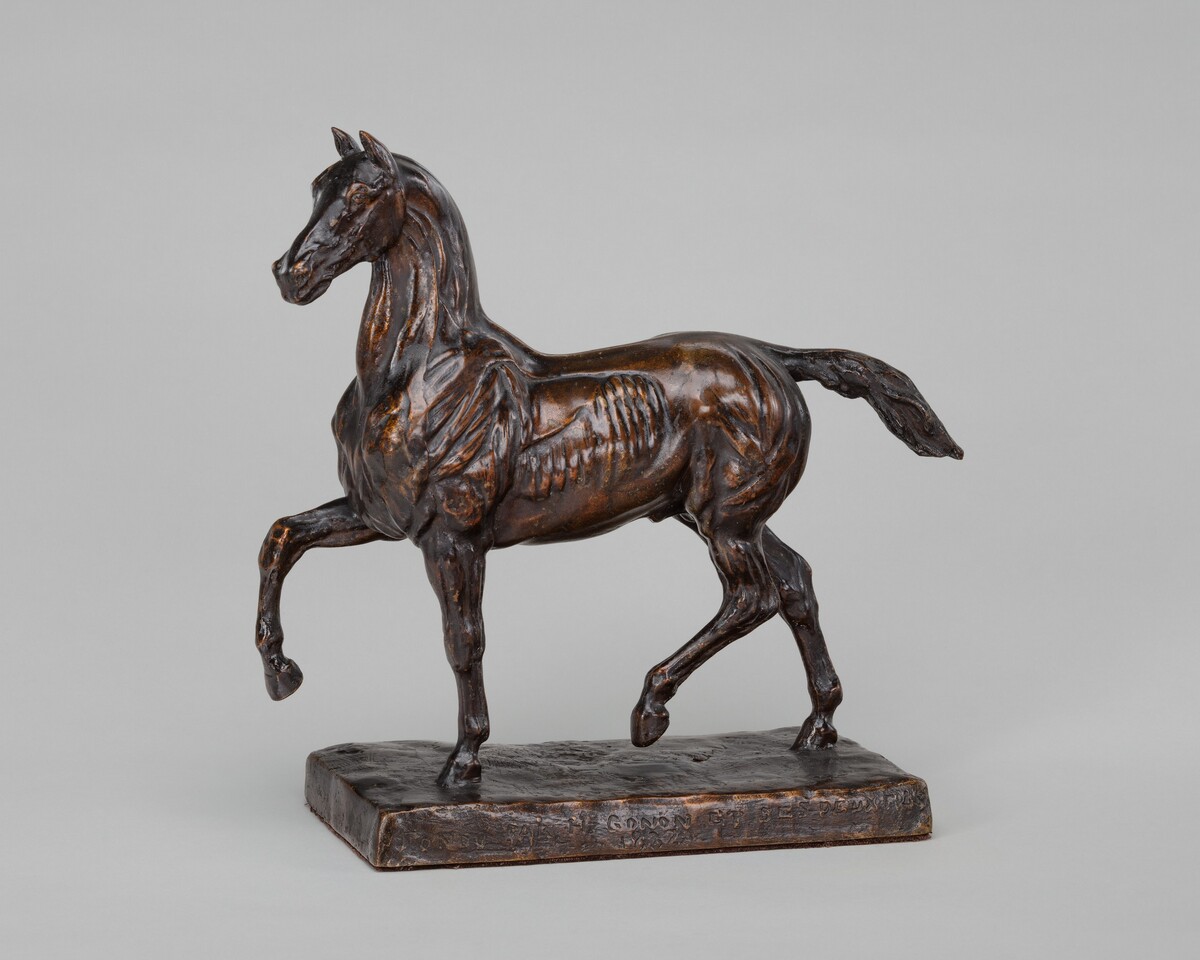
Provenance
Perhaps baron de Monville, active 1830s?-1860s; a gift possibly to an organization or charity sale.[1] Possibly Albert-Désiré Barre [d. 1878]; by descent through the family until 1968/1970.[2] Possibly (Georges Bernier, Paris), 1970.[3] (Cyril Humphris Ltd., London), 1970; sold 30 June 1971 to Mr. and Mrs. Paul Mellon, Upperville, Virginia;[4] gift 1980 to NGA.
[1] Based on the text of the handwritten note on the underside. The individual named there may be a baron de Monville whose titular property is in Gericault's native Seine-Maritime, around Rouen. He was well known in Paris in the 1860s as a collector of art bronzes and decorative arts, including a 45-centimeter sixteenth-century Italian human _écorché_. Many of his Italian bronzes were sold in a much-discussed (and as yet unidentified) sale in early February 1861 (Ernest Chesneau, "Gericault. Le Mouvement moderne en peinture" [offprint from _La Revue européenne_], Paris, 1861). He was later intimately involved in the efforts by the new applied-arts association (see the biography of Albert-Ernest Carrier-Belleuse) to found a "retrospective museum of industrial arts" similar to what is now the Victoria and Albert Museum, London (Charles Blanc, "L'Union Centrale des Beaux-Arts", _Gazette des Beaux Arts_ 7, 19 [1 September 1865]: 200, 204.) No nineteenth-century sculpture is as yet identified with Monville. It is tempting to associate with him or his family the "de Monville" collection, with Renaissance and French romantic paintings, drawings, and decorative objects, that was sold in Paris 7-10 March 1837. The precise relationship of this little-known nineteenth-century collector with François Nicolas-Henri Racine de Jonquoy, baron de Monville (1734-1797), the designer, builder, and owner of the Désert de Retz, the celebrated "psychological" folly garden at the northern end of Marly Forest, is unclear. See Diana Ketcham, _Le Désert de Retz. A Late Eighteenth-Century Folly Garden, The Artful Landscape of Monsieur de Monville_, Cambridge and London, 1997.
[2] The bronze reportedly belonged to a "M. Barre" in charge of the Paris Mint in the late nineteenth century (letter of 26 May 1971 from Cyril Humphris to Paul Mellon [in NGA curatorial files]). Younger brother of the better-known sculptor Jean-Auguste Barre (1811-1896), Albert-Désiré became "graveur général des monnaies" in 1855, succeeding their father Jean-Jacques in that position (Stanislas Lami, _Dictionnaire des sculpteurs de l'école française au dix-neuvième siècle_, 4 vols., Paris, 1914-1921, Reprint Nendeln, Kraus, 1970: 1:36). The National Gallery bronze was reportedly purchased privately from the descendants at the cited date by a Paris dealer (verbal communication, 1989, from an anonymous dealer).
[3] Lorenz A. Eitner, _Charles Clément: Géricault [sic]_, 1879 reprint with supplement, Paris, 1973: 460.
[4] In NGA curatorial files.
Accession Number
1980.44.8
Medium
bronze
Dimensions
overall: 24.1 x 24.8 x 11.7 cm (9 1/2 x 9 3/4 x 4 5/8 in.)
Classification
Sculpture
Credit Line
Collection of Mr. and Mrs. Paul Mellon