Provenance
Possibly Hélène Fourment [1614-1673], widow of the artist, Antwerp, by 1646; possibly John Robartes, 1st earl of Radnor [1606-1685], Lord Privy Seal to Charles II, London; possibly by inheritance to his son, Charles Bodville Robartes, 2nd earl of Radnor [1660-1723], London; (his sale, at his residence, London, 22-29 April 1724, no. 86, as by Van Dyck);[1] Thomas Scawen, London;[2] (his sale, at his residence, London, 25-28 January 1743, no. 49, bought in, possibly by Mr. Borroughs, a relative of Thomas Scawen);[3] "A Gent of the Law"; Sampson Gideon, Esq. [1699-1762], Belvedere, Erith, Kent, before 1755;[4] by inheritance to his son, Sir Sampson Gideon [assumed surname Eardley in 1789], 1st and last baron Spalding [1745-1824], Belvedere; by inheritance to his daughter, Charlotte-Elizabeth, and her husband, Sir Culling Smith, 2nd bt. [1768-1829], Belvedere; by inheritance to their son, Sir Culling Eardley Smith, 3rd bt. [later Sir Culling Eardley Eardley, 1805-1863], Belvedere, and Bedwell Park, near Hatfield, Hertfordshire; (his sale, Christie, Manson & Woods, London, 30 June 1860, no. 21, bought in);[5] by inheritance to his daughters, Frances Selena Eardley [Mrs. Culling Hanbury], Bedwell Park, and Isabella Maria Eardley [Mrs. William Henry Freemantle, d. 1901]; by inheritance, by 1927, to Colonel Francis E. Fremantle and Edward V.E. Fremantle, Esq.; purchased 5 August 1971 through (Thomas Agnew & Sons, Ltd., London) by NGA.
[1] George Vertue witnessed the sale and recorded it in his correspondence. See Clovis Whitfield, "Balthasar Gerbier, Rubens, and George Vertue," _Studies in the History of Art_ (1973): 25. Whitfield also notes that the painting may have been in the collection of the 11th earl of Radnor who, according to Samuel Pepys (diary reference 30 September 1661), had "two very fine pictures in the gallery" of his residence, Danvers House, in Chelsea, London.
[2] George Vertue notes that Scawen bought the painting at the Radnor sale. See Whitfield 1973, 27.
[3] The painting was possibly bought in at the Scawen sale and then bought afterwards by a Mr. Burroughs. See Whitfield 1973, 25, and Michael Jaffé, "Rubens's _Madame Gerbier and Her Children_," in _A Dealer's Record: Agnew's 1967-1981_, London, 1981: 75.
[4] Recorded in the possession of Gideon by James McArdell, who made a mezzotint copy of the work in 1755. He reports seeing it at Belvedere, Gideon's house in Kent. See Whitfield 1973, and Jaffé 1981, 75, who misdates the mezzotint as 1735. Thomas B.M. Martyn, _The English connoisseur: containing an account of whatever is curious in painting, sculpture, & c., in the palaces and the seats of the nobility and principal gentry of England, both in town and country_, 2 vols., London, 1766: 1:13, lists the painting among those at Belvedere House as "A Dutch Woman and her three Children" by "Sir Ant. More."
[5] The painting was apparently bought in by a Mr. Ward, whom Jaffé feels was an assumed name. Despite the high price the painting realized at the sale the work remained with the family by inheritance until its purchase by the NGA. See Jaffé 1981, 75. Whitfield 1973, 26, mentions, but does not elaborate on the identity of Mr. Ward.
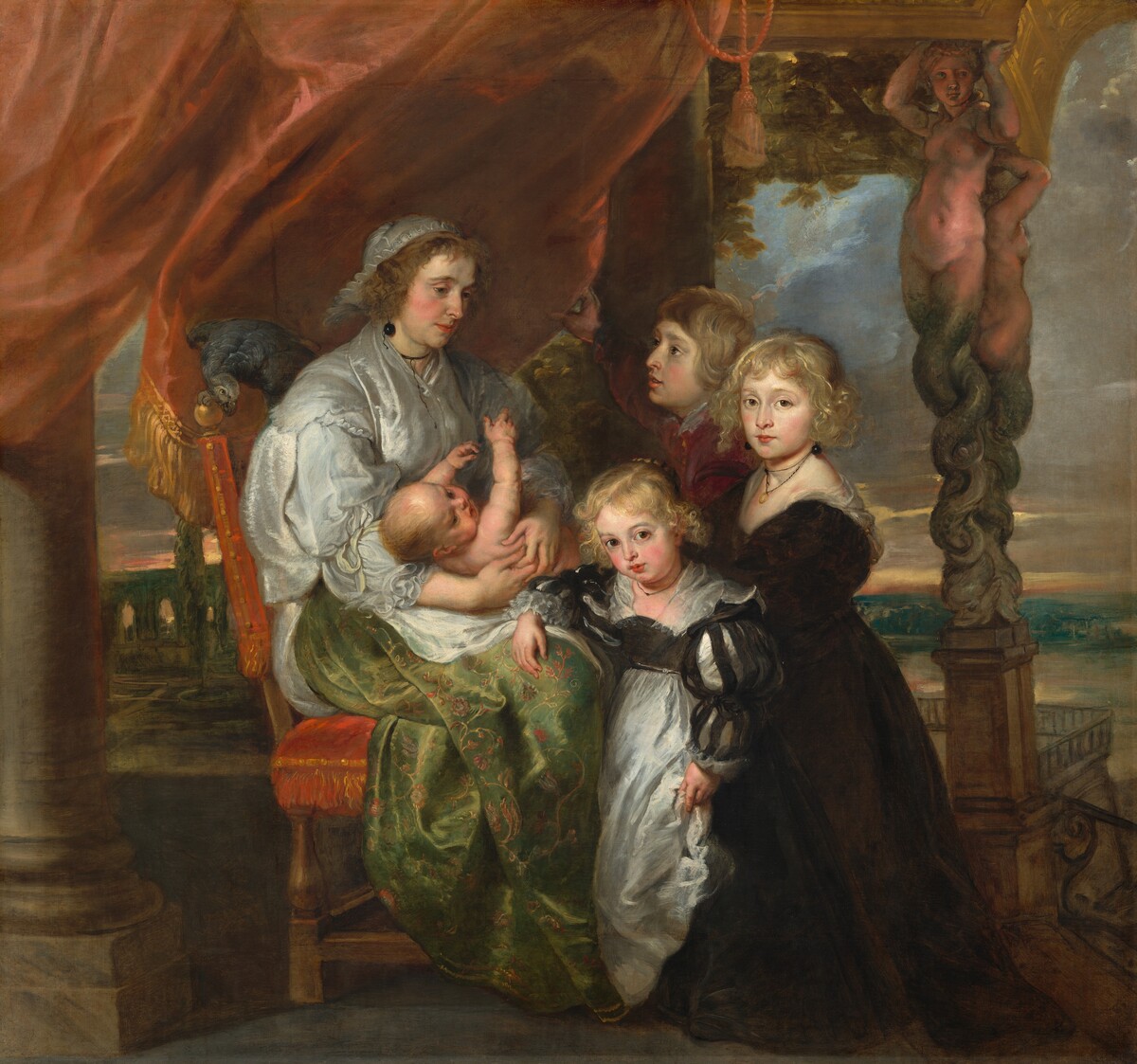
Deborah Kip, Wife of Sir Balthasar Gerbier, and Her Children
1629/1630, reworked probably mid 1640s
Accession Number
1971.18.1
Medium
oil on canvas
Dimensions
overall: 165.8 x 177.8 cm (65 1/4 x 70 in.) | framed: 200.34 x 211.14 x 14.61 cm (78 7/8 x 83 1/8 x 5 3/4 in.)
Classification
Painting
Credit Line
Andrew W. Mellon Fund
Tags
Painting Baroque (1600–1750) Oil Painting Canvas Flemish
Background & Context
Background Story
This portrait from 1629/1630, reworked probably in the mid 1640s, was painted by Sir Peter Paul Rubens (1577-1640) with possible contributions from Jacob Jordaens (1593-1678), depicting Deborah Kip, the wife of Sir Balthasar Gerbier, and her children. Rubens was the most important painter of the Flemish Baroque, known for the dynamic, colorful manner that revolutionized European painting, and this family portrait shows his ability to combine the grand manner of Baroque portraiture with the intimate feeling of a family group. The mid-1640s reworking of the painting likely involved Jordaens, Rubens's most important follower in Antwerp, who maintained the Rubens tradition after the master's death in 1640.
Cultural Impact
This portrait is important in the history of Flemish Baroque painting because it demonstrates the collaborative process that was central to the Rubens workshop and the continuation of the Rubens tradition by his followers. Rubens's family portraits—combining the grand manner of Baroque portraiture with the intimate feeling of a family group—represent one of the most accomplished types of Baroque portraiture, and the mid-1640s reworking shows how the Rubens tradition was maintained by followers like Jordaens after the master's death.
Why It Matters
This family portrait is Rubens at his most intimate: Deborah Kip and her children rendered in the grand manner of Baroque portraiture combined with the intimate feeling of a family group. The 1629/1630 painting, reworked in the mid 1640s possibly by Jordaens, shows the collaborative process of the Rubens workshop and the continuation of the Rubens tradition after the master's death.