Accession Number
1970.17.103
Medium
oil on canvas
Dimensions
overall: 49.2 x 140.9 cm (19 3/8 x 55 1/2 in.) | framed: 56.8 x 148.6 x 2.9 cm (22 3/8 x 58 1/2 x 1 1/8 in.)
Classification
Painting
Credit Line
Ailsa Mellon Bruce Collection
Tags
Painting Baroque (1600–1750) Oil Painting Canvas American
Background & Context
Background Story
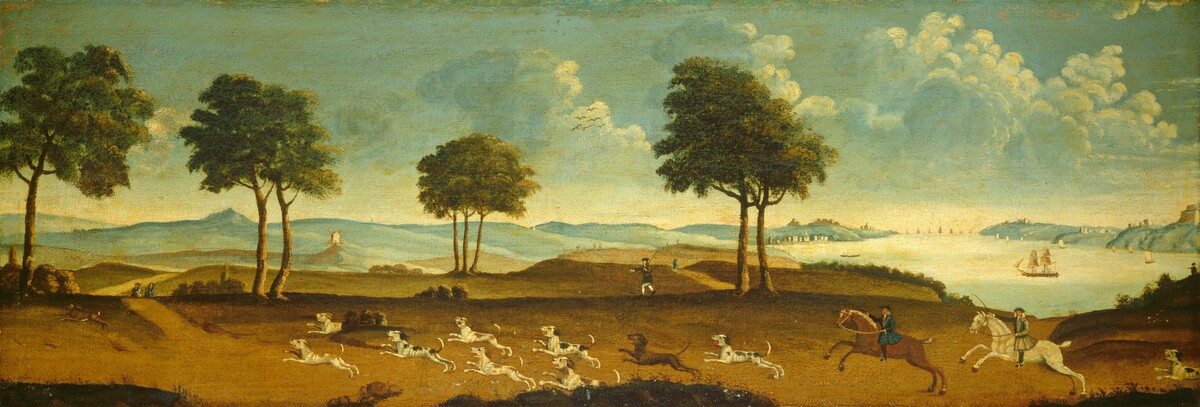
This hunting scene set against a harbor backdrop is a hybrid genre that was popular in Anglo-American art of the 18th century. Combining the sporting tradition of English hunting subjects with the marine painting tradition of harbor views, the unknown artist created a composition that served as both landscape and narrative. The harbor provides a sense of place and prosperity — ships mean trade, trade means wealth — while the hunting party demonstrates the leisure and social privilege that prosperity enables. The painting is essentially a portrait of a way of life rather than a portrait of an individual.
Cultural Impact
Hunting scenes with harbor views were a common decorative genre in prosperous colonial and Federal-era homes. They combined two aspirational subjects — the aristocratic pleasure of the hunt and the commercial wealth of maritime trade — into a single image of upper-class completeness. These paintings often hung in dining rooms and public spaces where they communicated the owner's social position to visitors.
Why It Matters
Hunting Scene with a Harbor is a visual encyclopedia of 18th-century American aspiration. It says: we hunt like English gentlemen and we trade like a maritime power. The combination is specifically American — European hunting scenes rarely bother with harbors.