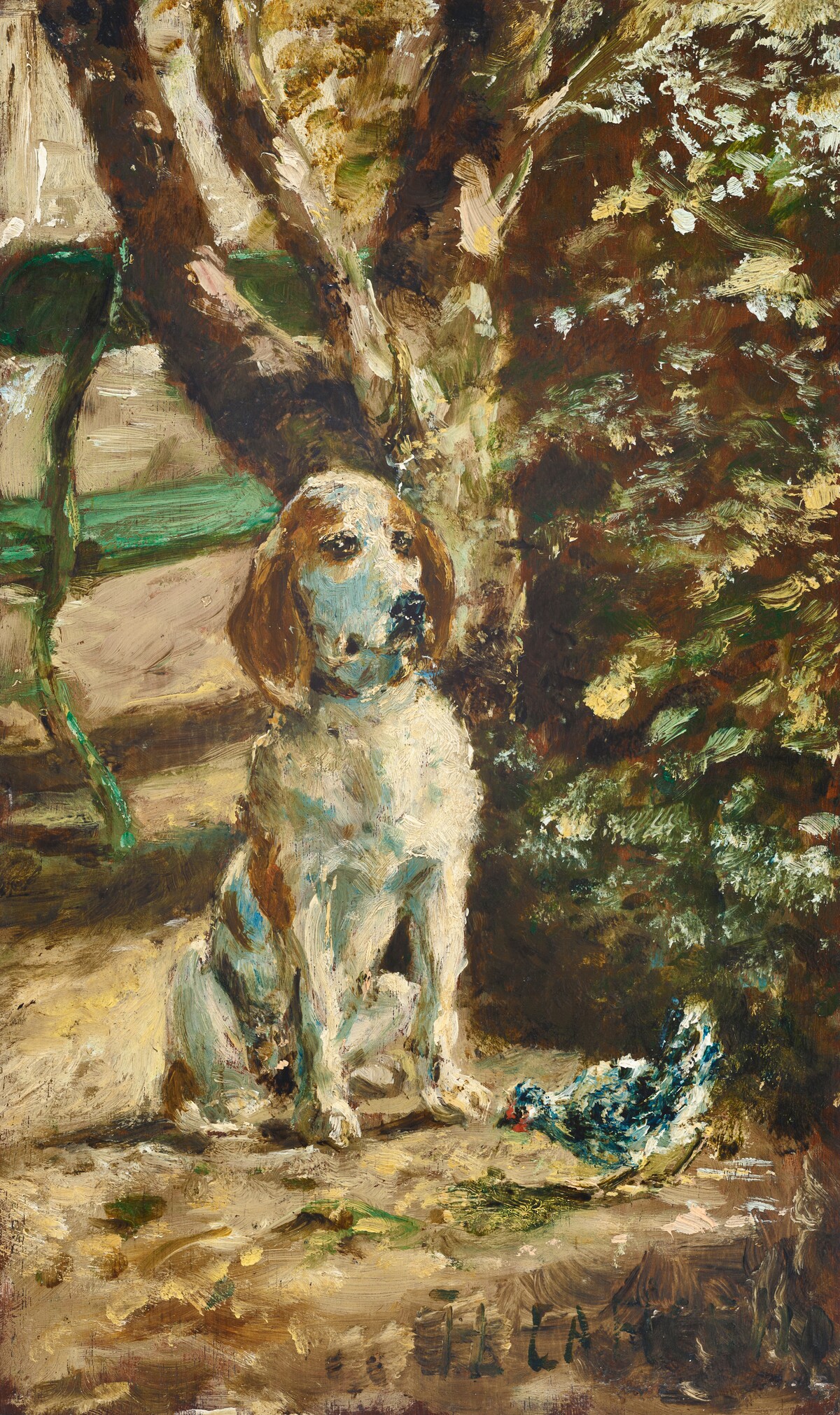
Provenance
Possibly Comte d'Anselme. Possibly Dr. Gabriel Tapié de Céléyran [1869-1930].[1] (Galerie André Weil, Paris). Capt. Edward H. Molyneux [1891-1974], Paris, by 1952;[2] sold 1955 to Ailsa Mellon Bruce [1901-1969], New York; bequest 1970 to NGA.
[1] d'Anselme and Tapié de Céléyran are according to labels on back of painting. The latter was a cousin of the artist, whose mother was Adèle Tapié de Céléyran.
[2] Exhibited with Molyneux collection in 1952.
Accession Number
1970.17.84
Medium
oil on wood
Dimensions
overall: 23.7 x 14.2 cm (9 5/16 x 5 9/16 in.) | framed: 38.4 x 29.9 x 7.3 cm (15 1/8 x 11 3/4 x 2 7/8 in.)
Classification
Painting
Credit Line
Ailsa Mellon Bruce Collection
Tags
Painting Impressionist & Modern (1851–1900) Oil Painting French
Background & Context
Background Story
The Artist's Dog Flèche (c. 1881) is a painting of Toulouse-Lautrec's beloved dog—an intimate and personal subject that reveals the private dimension of an artist whose public reputation was built on his depictions of Montmartre nightlife. Flèche (Arrow), the dog's name, suggests the swiftness and loyalty that Toulouse-Lautrec valued, and the painting's subject—the artist's companion animal—connects to a rich tradition in art history from Stubbs to Courbet. The 1881 date places this during Toulouse-Lautrec's youth, before his move to Montmartre, when he was still living in the family's estates and developing his art through portraits of the animals and people around him. The painting's intimacy—it depicts a beloved companion rather than a commissioned subject—gives it a warmth and immediacy that distinguish it from Toulouse-Lautrec's more famous works. His treatment of the dog demonstrates his ability to render animal form with the same sinuous line and character insight that he brought to human subjects. Flèche's presence in the painting also documents the companionship that the physically disabled artist valued—Toulouse-Lautrec, whose stunted legs made him an outsider in the aristocratic sporting world of his family, found in dogs and other animals the unconditional acceptance that human society sometimes denied him.
Cultural Impact
Toulouse-Lautrec's animal paintings influenced how companion animals were represented in modern art, combining character insight with the personal significance that these animals carried. The paintings influenced how the artist's private life was understood, revealing the emotional world that preceded and accompanied his public subjects. The dog portrait influenced how Toulouse-Lautrec's development was reconstructed, documenting the observational skills that preceded his Montmartre work.
Why It Matters
This painting matters because it reveals the private dimension of an artist famous for public subjects—the companionship that Flèche provided and the emotional world that Toulouse-Lautrec's depictions of nightlife sometimes conceal. The dog portrait argues that artistic significance is not limited to fashionable subjects but can emerge from the most personal and intimate encounters with the beings that share our lives.