Provenance
Moïse Lévy de Benzion, Paris.[1] (sale, Hôtel Drouot, Paris, 29 November 1949, no. 80). E. Slater; sold 1950 to (Alex Reid and Lefevre, Glasgow and London); sold 1951 to Capt. Edward H. Molyneux [1891-1974], Paris;[2] sold 15 August 1955 to Ailsa Mellon Bruce [1901-1969], New York; bequest 1970 to NGA.
[1] This painting was confiscated by the Nazi Einsatzstab Reichsleiter Rosenberg (ERR) from the Levy de Benzion collection in France. The painting was selected by Hermann Goering on 25 November 1942 from the Jeu de Paume (OSS Consolidated Interrogation Report #2, The Goering Collection, 15 September 1945, Attachment 5, Liste der für die Sammlung des Reichsmarschalls Hermann Göring abgegebenen Kunstgegenstände, dated 20 October 1942, 1. Nachtrag, no. 67, National Archives RG239/Entry 73/Box 78, copy in NGA curatorial files). The records of the Munich Central Collecting Point indicate that the painting was recovered in Berchtesgaden and restituted to France on 18 April 1946 (Munich property card no. 5914; French Receipt for Cultural Objects no. 6A, item no. 950, National Archives RG260/Ardelia Hall/Box 286 copies NGA curatorial files). The painting was returned to the Levy de Benzion family on 10 May 1946.
[2] See letter from Alex Reid & Lefèvre, dated 18 August 1977, in NGA curatorial files.
Accession Number
1970.17.13
Medium
oil on wood
Dimensions
overall: 18.4 x 27.4 cm (7 1/4 x 10 13/16 in.) | framed: 30.8 x 39.7 x 3.8 cm (12 1/8 x 15 5/8 x 1 1/2 in.)
Classification
Painting
Credit Line
Ailsa Mellon Bruce Collection
Tags
Painting Impressionist & Modern (1851–1900) Oil Painting French
Background & Context
Background Story
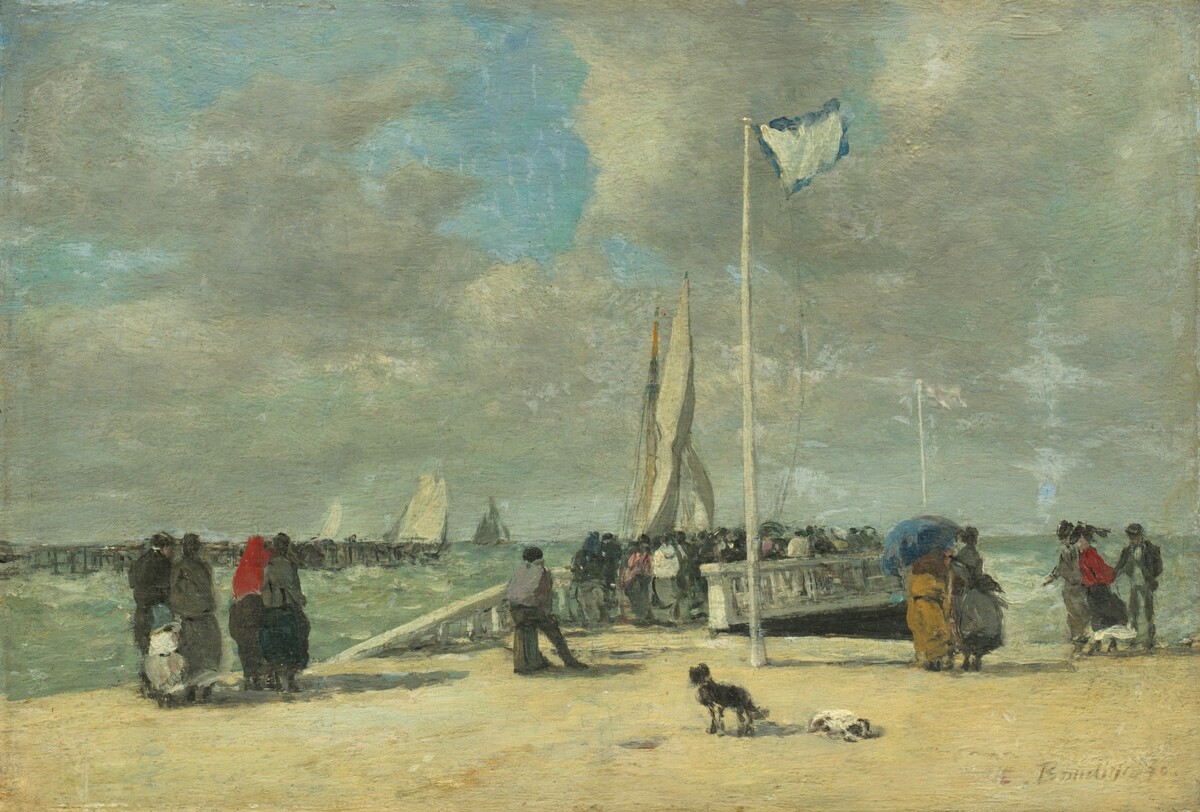
On the Jetty (c. 1869/1870) depicts a scene that Boudin knew intimately: the jetties and seawalls of Normandy's coastal towns where fishermen, merchants, and visitors conducted the daily business of port life. The jetty—.stone structure extending into the harbor—was the interface between land and sea, the place where the maritime world met the shore-based economy. Boudin's painting captures this interface with the sociological precision that distinguishes his best genre work: the figures on the jetty are not generalized types but specific individuals—fishermen, merchants, tourists—whose dress, posture, and activities reveal their social positions and purposes. The 1869-70 date places this at the moment when Boudin was mentoring the young Claude Monet, taking him on painting expeditions and encouraging him to paint outdoors. The jetty subject—combining marine observation with social observation—was exactly the kind of scene that Boudin encouraged Monet to study. The painting's attention to the jetty's human activity—the social life of the waterfront—demonstrates Boudin's understanding that ports were not merely industrial sites but social environments where maritime and terrestrial cultures intersected. This social dimension, combined with Boudin's atmospheric mastery, creates paintings that serve both documentary and aesthetic purposes.
Cultural Impact
Boudin's jetty paintings influenced how Normandy's port life was represented in art, combining marine painting with genre observation in a way that influenced the Impressionists. The paintings influenced how the social dimension of port life was depicted, establishing conventions for waterfront genre scenes that persisted through Impressionism. The jetty subject also influenced tourism imagery for Normandy's coastal towns.
Why It Matters
This painting matters because it captures the social dimension of port life that pure marine painting often overlooks. The jetty is not just a maritime structure—it is a social space where different communities meet, and Boudin's attention to this social function creates images that document the cultural complexity of Normandy's coastal communities as effectively as they capture their atmospheric beauty.