Accession Number
1969.12.2
Medium
oil on fabric
Dimensions
overall: 76.2 x 111.8 cm (30 x 44 in.) | framed: 92.7 x 128.3 x 5.1 cm (36 1/2 x 50 1/2 x 2 in.)
Classification
Painting
Credit Line
Gift of Dr. Catherine Lilly Bacon
Tags
Painting Neoclassical & Romantic (1751–1850) Oil Painting Chinese
Background & Context
Background Story
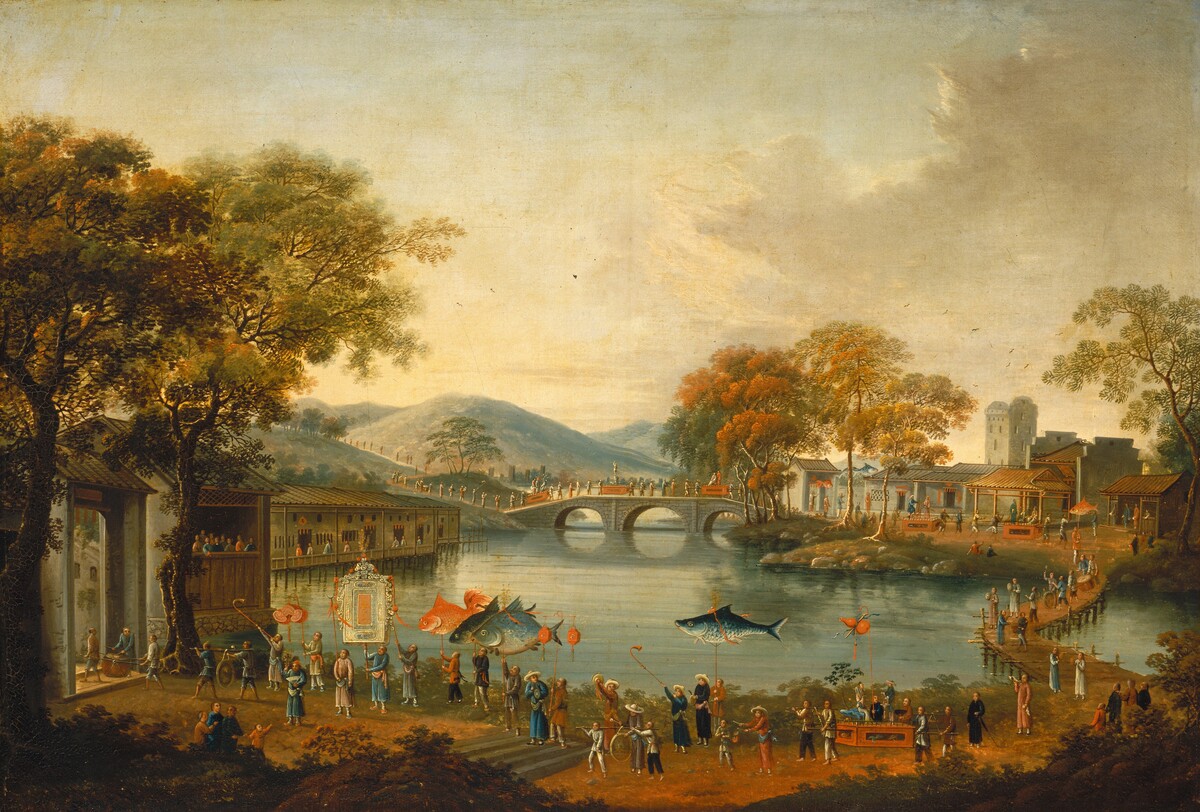
The "Procession by a Lake" is a Chinese export painting of the nineteenth century, executed in oil on fabric — a medium that marks it as a product of the Canton (Guangzhou) export painting workshops that produced images of Chinese life for the Western market. The painting depicts a formal procession moving along the shore of a lake, with figures in official dress, banners, attendants, and possibly sedan chairs, portraying the hierarchical social order and ceremonial life of Qing dynasty China.
Processions were among the most visually spectacular events in Qing dynasty China. Official processions — marking the arrival or departure of a magistrate, the celebration of a festival, or the observance of a ritual — involved large numbers of participants dressed in prescribed costumes, carrying banners, musical instruments, and sedan chairs arranged in strict hierarchical order. These processions served as public demonstrations of authority, reinforcing the social and political order that governed Chinese life. For Western observers, they were among the most memorable spectacles of Chinese culture, combining visual grandeur with an unfamiliar social structure.
The Canton export painting workshops that produced images like this one were highly organized operations that employed trained Chinese artists in the production of paintings for foreign buyers. The workshops developed a distinctive hybrid style that combined Chinese subject matter with Western techniques of perspective, shadow, and oil painting. The result was a category of art that was neither traditionally Chinese nor purely Western, but a product of the cultural exchange that characterized the Canton trade system — the complex network of commercial, diplomatic, and cultural interactions that connected China to Europe and America through the single port of Canton.
The use of oil on fabric indicates that this painting was produced for the export market rather than for domestic consumption. Traditional Chinese painting used ink and mineral pigments on silk or paper, but export paintings adopted Western oil painting techniques to satisfy the expectations of foreign buyers who valued the realism and durability of oil paint. Fabric was a practical support for export paintings: cheaper than canvas, lighter than wood panels, and easy to roll for shipping. The workshops also produced oil paintings on canvas, glass, and parchment, as well as watercolors on pith paper (the "rice paper" paintings that were especially popular with Western buyers).
These export paintings have gained scholarly attention in recent decades as important documents of Sino-Western cultural exchange, preserving visual information about Qing dynasty architecture, costume, ceremony, and daily life that is unavailable from other sources.
Cultural Impact
Chinese export paintings document the visual culture of Qing dynasty China from a unique perspective — that of Chinese artists producing images for Western consumption, creating a hybrid visual language that was neither purely Chinese nor purely Western.
Why It Matters
This painting of a formal lakeside procession exemplifies the Canton export art tradition — Chinese subject matter rendered in Western oil technique for the foreign market, preserving a vivid record of Qing dynasty ceremonial life.