Accession Number
1969.12.1
Medium
oil on cotton
Dimensions
overall: 77.8 x 110.8 cm (30 5/8 x 43 5/8 in.) | framed: 94 x 128.6 x 5.1 cm (37 x 50 5/8 x 2 in.)
Classification
Painting
Credit Line
Gift of Dr. Catherine Lilly Bacon
Tags
Painting Neoclassical & Romantic (1751–1850) Oil Painting Chinese
Background & Context
Background Story
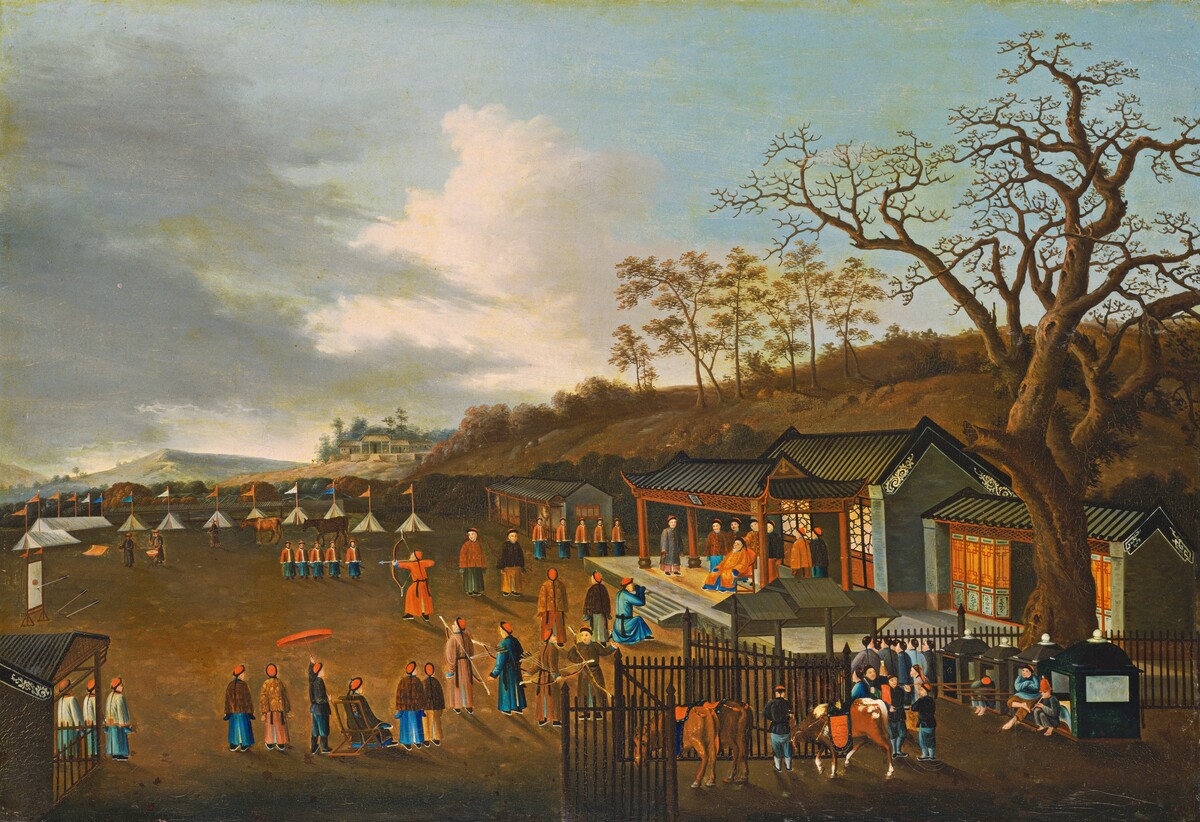
The "Archery Contest" is a Chinese export painting of the nineteenth century, rendered in oil on cotton — a medium and support that reflect the complex cultural exchange between China and the West during the Qing dynasty. The painting depicts a formal archery competition, probably held at the imperial court or a military training ground, showing Qing dynasty archers demonstrating their skill with the composite bow, a weapon that was central to Manchu military tradition and identity.
Archery held a special significance in Qing dynasty China. The Manchu rulers who founded the Qing dynasty (1644–1912) were originally a nomadic people from the northeastern steppes, and they maintained archery as a core military skill and cultural practice throughout their reign. The Qing imperial examinations for military officials required candidates to demonstrate proficiency in archery, and the emperor himself was expected to be an accomplished archer. Annual archery contests at the imperial court were important ritual occasions that reinforced Manchu martial identity and reminded the court of its nomadic origins.
The painting's medium — oil on cotton — indicates that it was produced for the export market rather than for domestic Chinese consumption. Chinese export paintings, produced in large quantities in the port cities of Canton (Guangzhou) and Hong Kong, were made in workshops that employed Chinese artists trained in Western oil painting techniques. These artists produced images of Chinese life, scenery, and customs that satisfied Western curiosity about the "exotic" East while conforming to Western expectations of what Chinese subjects should look like. The result was a hybrid art form that was neither authentically Chinese in the traditional sense nor Western in its subject matter.
The export painting trade flourished from the mid-eighteenth century through the nineteenth century, fueled by European and American demand for visual souvenirs of China. The paintings ranged from detailed renderings of Chinese craftsmanship and manufacturing processes (tea production, silk weaving, porcelain making) to panoramic views of Canton and its waterfront to genre scenes like this archery contest. While often dismissed by art historians as commercial products rather than fine art, export paintings are increasingly recognized as important documents of cross-cultural encounter, preserving information about Chinese life, customs, and material culture that would otherwise be lost.
Cultural Impact
Chinese export paintings represent one of the earliest and most extensive examples of cross-cultural artistic production, creating a hybrid visual language that satisfied Western curiosity about China while employing Chinese artistic skill.
Why It Matters
This Qing dynasty archery contest, painted in oil on cotton for the Western market, documents Manchu martial traditions while exemplifying the cultural exchange that characterized China's export art trade in the nineteenth century.