Provenance
François Depeaux [1853-1920], Rouen; (his sale, Galerie Georges Petit, 31 May - 1 June 1906, no. 74, as _Intérieur de cabaret_); purchased by (Durand-Ruel)[1] probably for Otto Gerstenberg [1848-1935], Berlin; by inheritance to his daughter, Margarethe Scharf; sold 1951 to (Carstairs Gallery, New York);[2] sold 20 March 1951 to Chester Dale [1883-1962], New York;[3] bequest 1963 to NGA.
[1] Annotated sales catalogue, Getty Research Institute, Los Angeles (copy in NGA curatorial files).
[2] Gerstenberg's great-granddaughter, Julietta Scharf, kindly shared information about her family's ownership of the painting in e-mails of 20 October and 5 November 2009 (in NGA curatorial files). Documentation from her grandmother, Margarethe Scharf, indicates that Otto Gerstenberg acquired the painting at the 1906 sale, and that Margarethe inherited the painting on her father's death. After Margarethe lent the painting to an exhibition at the Statens Museum for Kunst in Copenhagen in 1936, the director of that museum offered to store it for her during World War II. After the war, Margarethe asked the director to arrange for it to be sold. See also Thomas W. Gaehtgens and Julietta Scharf, "Die Sammlung Otto Gerstenberg in Berlin," in _Die Moderne und ihre Sammler: Französische Kunst in Deutschem Privatbesitz vom Kaiserreich zur Weimarer Republik_, Andrea Pophanken and Felix Billeter, eds., Berlin, 2001: 183. Incorrectly, M.G. Dortu, _Toulouse-Lautrec et son oeuvre_, 6 vols., New York, 1971: 2:262, does not include Gerstenberg in his provenance for the painting.
[3] Chester Dale papers, in NGA curatorial files
Accession Number
1963.10.67
Medium
oil on cardboard
Dimensions
overall: 100 x 89.2 cm (39 3/8 x 35 1/8 in.) | framed: 132.4 x 122.6 cm (52 1/8 x 48 1/4 in.)
Classification
Painting
Credit Line
Chester Dale Collection
Tags
Painting Impressionist & Modern (1851–1900) Oil Painting Board French
Background & Context
Background Story
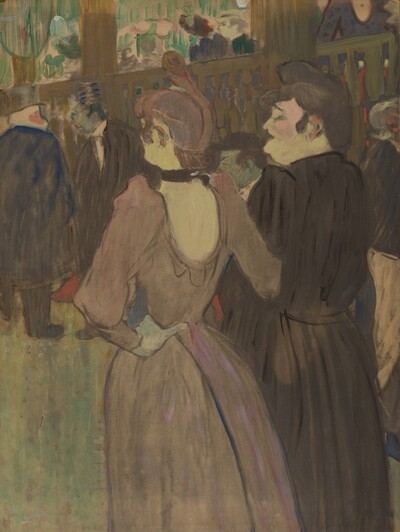
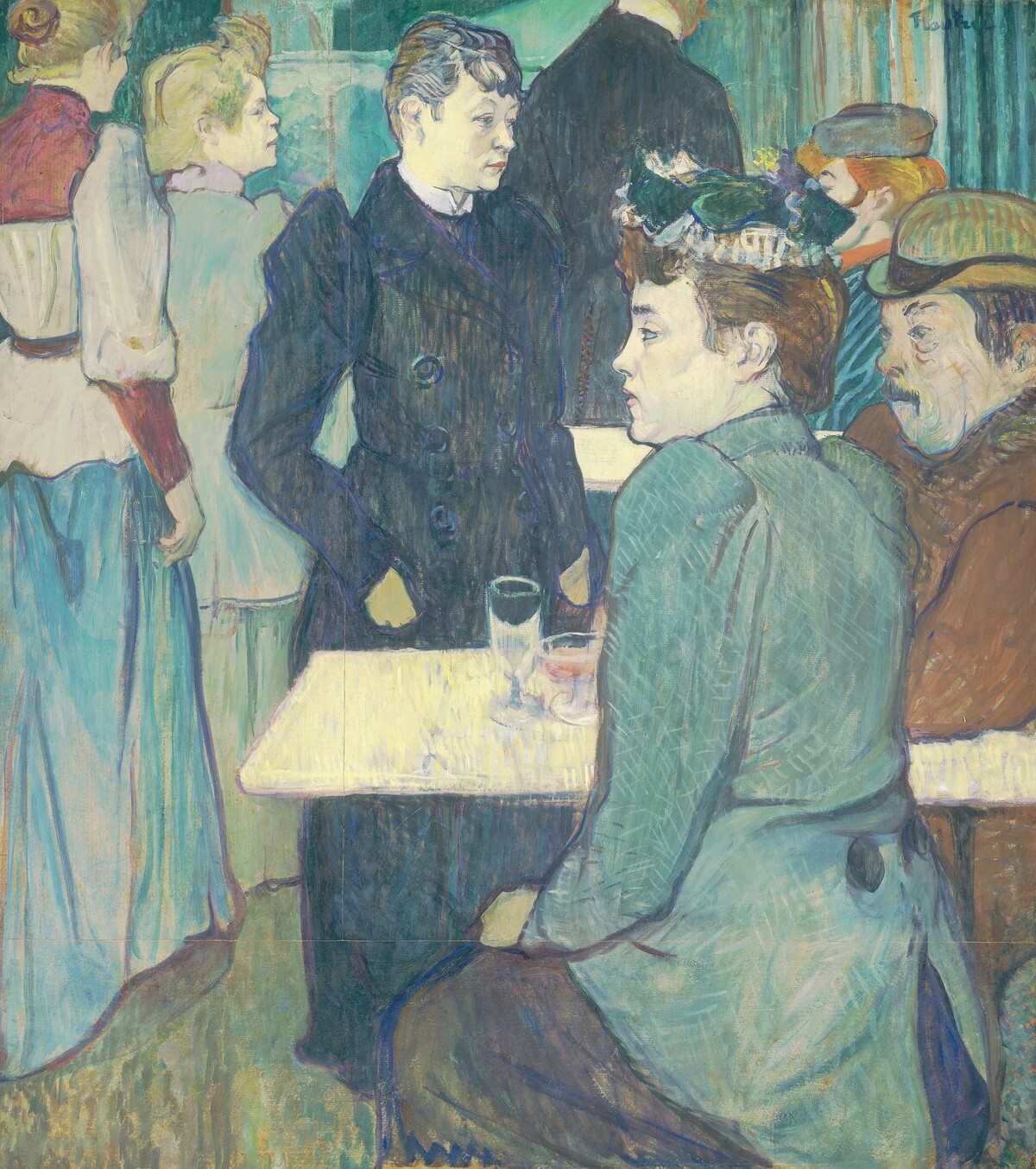
A Corner of the Moulin de la Galette (1892) depicts the famous Montmartre dance hall that was one of the most significant sites in the history of Impressionist and Post-Impressionist painting. Renoir's celebrated 1876 painting of the same subject had established the Moulin de la Galette as an artistic subject, and Toulouse-Lautrec's 1892 treatment offered a very different vision of the same location. Where Renoir had celebrated the dance hall's democratic joy, Toulouse-Lautrec revealed its harder reality—the performers, the prostitutes, and the commercial mechanisms that made the spectacle possible. The 1892 date places this during Toulouse-Lautrec's most intensive Montmartre period, when he was painting the entertainment world from the perspective of an insider who understood its commercial and sexual economies. His treatment of the Moulin de la Galette's corner—a partial view rather than the comprehensive scene Renoir had painted—reflects his preference for the fragment over the whole, the revealing detail over the panoramic view. The figures in Toulouse-Lautrec's version are not the joyous dancers of Renoir's painting but the working people of the entertainment industry—their faces individual, their expressions guarded, their presence defined by the commercial transactions that sustained the dance hall. This contrast between Renoir's celebration and Toulouse-Lautrec's revelation influenced how Montmartre was subsequently represented in art and literature.
Cultural Impact
Toulouse-Lautrec's Moulin de la Galette influenced how the entertainment industry was represented in art, revealing the commercial and sexual economies that produced the spectacle. The painting influenced later artists who similarly sought the reality behind the entertainment—.tradition extending from the Weimar cabaret paintings of Christian Schad and Otto Dix to contemporary investigations of the sex industry. The comparison with Renoir's treatment influenced how Impressionist and Post-Impressionist representations of leisure were distinguished.
Why It Matters
This painting matters because it offers the corrective to Renoir's celebratory vision—revealing the Moulin de la Galette as a working commercial enterprise rather than a democratic paradise. Toulouse-Lautrec's corner view argues that the truth of any social institution lies in its working mechanisms rather than in its public presentation, and that art's responsibility is to reveal these mechanisms rather than to conceal them.