Provenance
Private collection, Saxony.[1] Possibly (Sabin, London); sold 1928 to (Karl Haberstock, Berlin), possibly until 1936.[2] Acquired by Dr. Gustav Mez [d. 1944], Rorschacherberg, Switzerland;[3] (Rosenberg and Stiebel, New York); purchased 1951 by the Samuel H. Kress Foundation, New York;[4] gift 1961 to NGA.
[1] A photograph of the painting in the Witt Library, London, is inscribed with the information that the painting was once in the collection of Augustus III, elector of Saxony (see photocopy in NGA curatorial files.)
[2] Karl Haberstock appears to have handled two Bellotto views of Munich: the Gallery version and one that was sold to the Sonderauftrag Linz, processed through the Munich Central Collecting Point (no. 7573) in 1945, transferred in 1949 to the German government, and sent to the Auswärtig Amt in 1962 (see photocopies from the Bundesarchiv, Koblenz, in NGA curatorial files). This other version, first published by Andrzej Rottermund in 1998 (see bibliography), was auctioned by Koller International Auctions in Zurich on 1 October 2021. One of the two Bellottos was acquired by Haberstock from Sabin in London in April 1928 (see photocopies from Haberstock-archiv in NGA curatorial files), and at least one was still in his possession as of 1936, per Hellmuth Allwill Fritzsche, Bernardo Bellotto, genannt Canaletto, Burg-bei-Magdeburg, 1936: 116.
[3] According to Saemy Rosenberg (letter of 7 December 1955, to NGA curator Fern Rusk Shapley, in NGA curatorial files), the painting was acquired by a private collector from a Dresden collection during World War II. Stefan Kozakiewicz, in his 1972 catalogue raisonné, identified the collector as Gustav Mez, a German resident in Switzerland (see bibliography). It is possible that both this painting and its companion (NGA 1961.9.63) were acquired by Mez from Haberstock in 1929, when the third painting of the group (replicas of the originals in the electoral palace painted for Elector Maximilian III Joseph) was sold.
[4] See The Kress Collection Digital Archive, https://kress.nga.gov/Detail/objects/2438.
Accession Number
1961.9.64
Medium
oil on canvas
Dimensions
overall: 69.2 x 119.8 cm (27 1/4 x 47 3/16 in.) | framed: 86.4 x 137.2 x 8.9 cm (34 x 54 x 3 1/2 in.)
Classification
Painting
Credit Line
Samuel H. Kress Collection
Tags
Painting Neoclassical & Romantic (1751–1850) Oil Painting Canvas Italian
Background & Context
Background Story
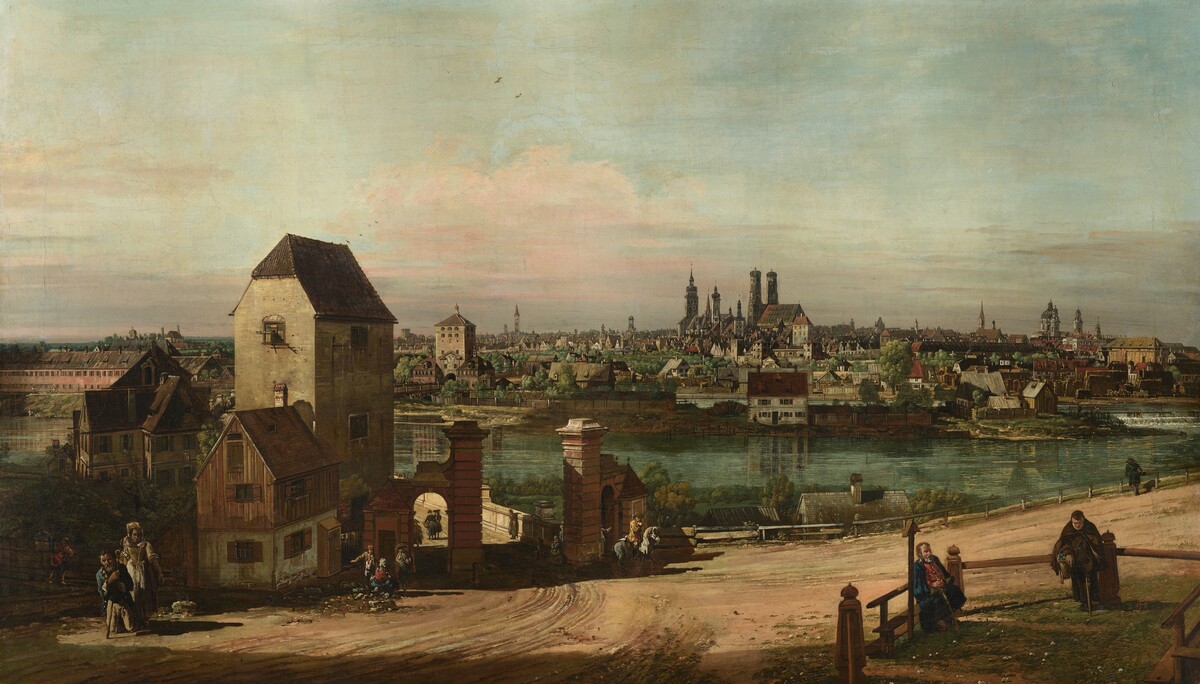
Bernardo Bellotto's "View of Munich" (c. 1761) is one of a series of topographical city views that this Venetian-born painter produced for the Bavarian court, depicting the capital of the Electorate of Bavaria with the same precision and grandeur he had brought to views of Dresden, Warsaw, and Turin. The painting presents Munich's distinctive skyline of church towers, domes, and civic buildings from an elevated vantage point, combining the accuracy of a topographical document with the compositional sophistication of a veduta — the Italian tradition of cityscape painting that Bellotto had inherited from his famous uncle, Canaletto.
Bellotto (1721–1780) trained in the Venice studio of his uncle Giovanni Antonio Canal, called Canaletto, whose name he would later adopt as his own in foreign courts. By the early 1740s, Bellotto was producing views of Venice that rivalled his uncle's in precision and compositional complexity, and by the late 1740s he had left Italy for a peripatetic career that would take him to Dresden, Vienna, Munich, and finally Warsaw. His city views, commissioned by the rulers of each city he visited, serve today as invaluable historical documents — records of urban landscapes that have often been altered or destroyed by war and development.
The Munich views were commissioned by Elector Maximilian III Joseph of Bavaria, who brought Bellotto to Munich in 1761 to record the city's appearance. The resulting paintings document Munich's eighteenth-century urban fabric with extraordinary precision: individual buildings are rendered with architectural exactitude, the street life is described in ethnographic detail, and the quality of the Bavarian light is captured with a luminosity that transforms documentation into art. Bellotto's technique — particularly his use of a camera obscura to establish the basic outlines of his compositions — gave his views an optical accuracy that distinguishes them from the more picturesque but less precise vedute of his contemporaries.
What separates Bellotto's city views from mere topographical illustration is their compositional sophistication. The "View of Munich" is not a random snapshot but a carefully constructed image: the vantage point is chosen to reveal the city's most significant buildings in their spatial relationships, the foreground is populated with genre figures that provide scale and animation, and the atmospheric effects — the warm light of a late afternoon, the slight haze that softens distant buildings — create a sense of specific time and place. The workshop assistance indicated by the attribution reflects Bellotto's standard practice of delegating secondary areas of his canvases to trained assistants while executing the key passages himself.
Cultural Impact
Bellotto's city views served as both artistic achievements and historical documents, preserving detailed records of European capitals that would guide post-war reconstruction efforts in Warsaw and Dresden and influence the development of topographical painting across Europe.
Why It Matters
"View of Munich" exemplifies Bellotto's dual achievement — combining the topographical precision of a documentary record with the compositional grandeur and atmospheric subtlety of Italian veduta painting, creating images that serve as both historical documents and works of art.