Provenance
Casimir Perrin, marquis de Cypierre [1783-1844], Paris; (his estate sale, at his residence by Thoré, Paris, 10 March 1845 and days following, no. 52 or 53).[1] possibly marquise de Montesquiou-Fezensac, Paris;[2] Camille Groult [1837-1908], Paris, possibly from 1889, to1908.[3] (Wildenstein & Co., New York); sold February 1954 to the Samuel H. Kress Foundation, New York;[4] gift 1961 to NGA.
[1] This is the first confirmed record of the painting. For discussion of possible earlier provenance now rejected by scholars, see Richard Rand's entry on this painting and its pendant, _Blindman's Buff_ (NGA 1961.9.16), in Philip Conisbee, et al., _French Paintings of the Fifteenth through the Eighteenth Century_, The Collections of the National Gallery of Art Systematic Catalogue, Washington, 2009: 199, 202 nn. 13, 14.
[2] The pair of paintings were possibly the two Fragonards sold from the Montesquiou-Fezensac collection to Henri Haro, buying for Camille Groult, prior to its 1897 sale at Hôtel Drouot, Paris, 19 March 1897; see Colin Eisler, _Paintings from the Samuel H. Kress Collection: European Schools Excluding Italian_, Oxford, 1977: 331 n. 17.
[3] Groult's ownership was incorrectly given as "until at least 1889" in the provenance for the painting published in the NGA's 2009 catalogue (see note 1). Thanks to correspondence from Olafur Thorvaldsson (e-mail of 27 September 2019, in NGA curatorial files), Groult's ownership can be further clarified.
Groult was given as the owner of the paintings in publications of 1889 (Portalis; who actually places only NGA 1961.9.16 in Groult's collection, and confuses the provenances of three paintings in his entry), 1906 (Nolhac), 1908 (Flament; kindly sent to NGA by Mr. Thorvaldsson), and 1927 (Reau). If Groult did not acquire the paintings until 1897 (see note 2 about this possibility), the 1889 publication is in error. Since Groult died in 1908, the 1927 publication must have meant he was a former owner, although it is possible the painting was inherited by his son, Jean Groult (1868-1951). The painting was not included in the 21 March 1952 sale of the Groult collection.
[4] The bill of sale (copy in NGA curatorial files, see also The Kress Collection Digital Archive, https://kress.nga.gov/Detail/objects/2302) is dated February 10, 1954, and was for a total of fourteen paintings; payments by the Foundation continued to March 1957.
Accession Number
1961.9.17
Medium
oil on canvas
Dimensions
overall: 215.9 × 185.5 cm (85 × 73 1/16 in.) | framed: 246.38 × 215.9 × 16.51 cm (97 × 85 × 6 1/2 in.)
Classification
Painting
Credit Line
Samuel H. Kress Collection
Tags
Painting Neoclassical & Romantic (1751–1850) Oil Painting Canvas French
Background & Context
Background Story
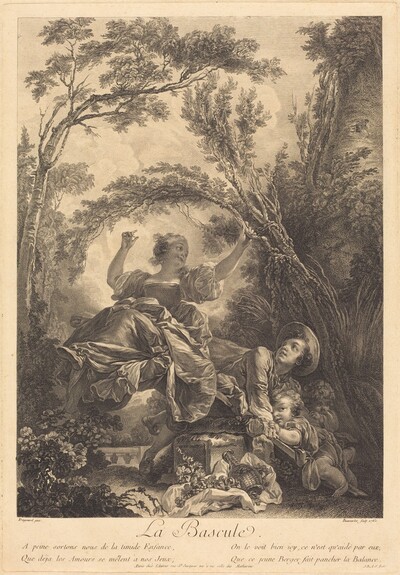
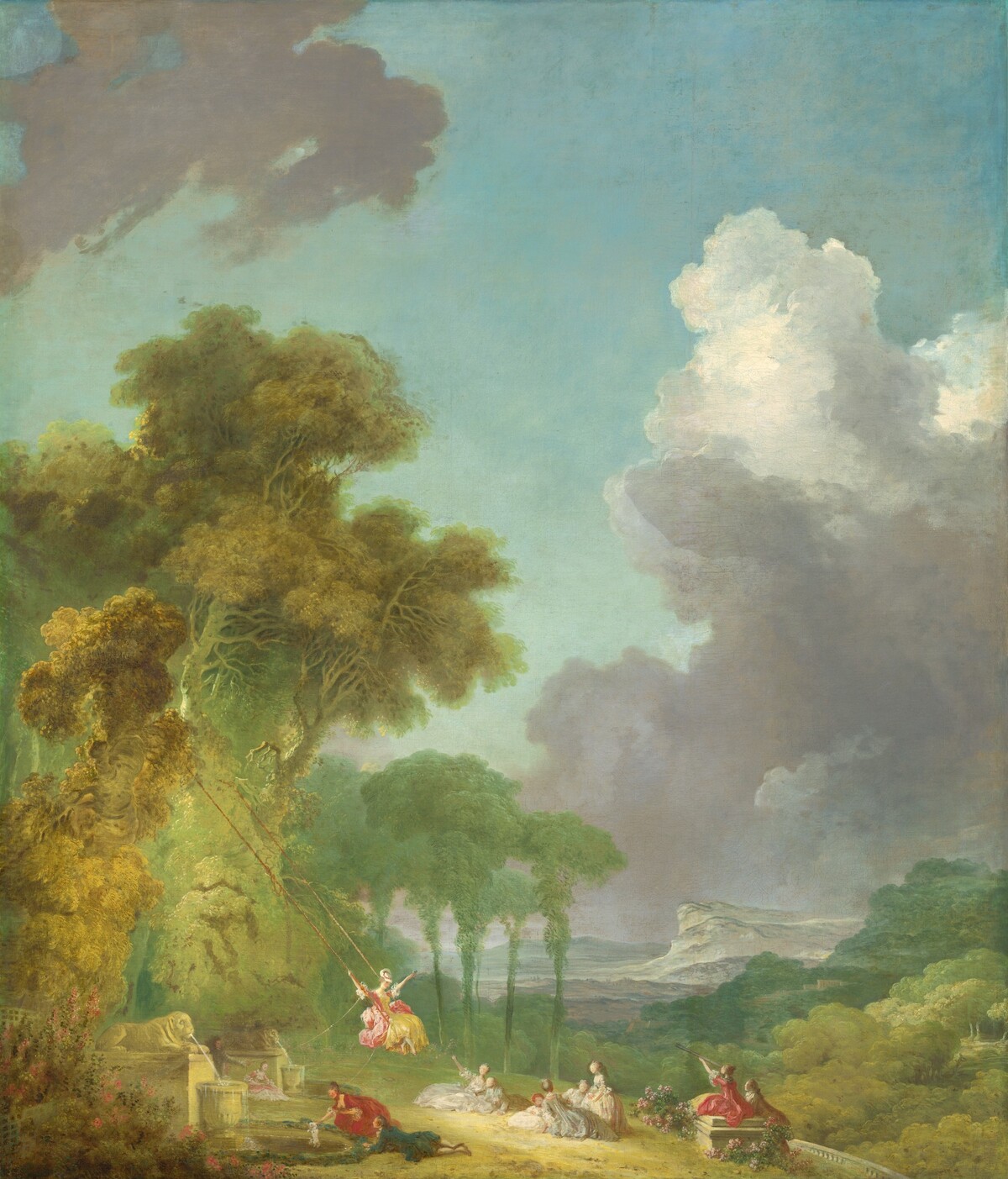
The Swing (c. 1767) is Fragonard's most celebrated painting and the quintessential image of the Rococo—a depiction of aristocratic pleasure that combines erotic suggestion, decorative elegance, and the playful spirit that defined the ancien régime before the Revolution. The painting shows a young woman swinging in a garden while her lover conceals himself in the bushes below, and an older man—likely her husband—pushes the swing from behind. The composition's erotic logic is explicit: the swinging woman's raised leg reveals her ankles and more to the concealed lover, who reaches toward her from the shrubbery. This triangular arrangement—wife, lover, and unknowing husband—creates the narrative of deception that gives the painting its frisson. The 1767 date places this at the height of Fragonard's career, when his handling was at its most fluent and his palette at its most voluptuous. The garden setting, with its formal layout, its statuary, and its dense foliage, creates the outdoor theater where the Rococo's characteristic drama of pleasure and deception unfolds. The swing itself—the device that lifts the woman above both men—was the Rococo's most sexually charged garden amusement, and Fragonard's painting made it the definitive image of ancien régime libertinage. The painting's influence on subsequent art and culture has been immense: it became the visual shorthand for the Rococo's elegant decadence.
Cultural Impact
Fragonard's The Swing became the most influential image of the Rococo, defining the style's celebration of pleasure for subsequent centuries. The painting influenced every subsequent engagement with the Rococo, from 19th-century revival to 20th-century design. The swing subject influenced how aristocratic libertinage was visually represented, establishing conventions that persisted until the present. The painting influenced fashion, design, and popular culture, becoming the Rococo's most recognizable image.
Why It Matters
This painting matters because it is the Rococo—the most perfect expression of the style's celebration of pleasure, elegance, and the playful deception that aristocratic society both practiced and enjoyed. The Swing's combination of erotic suggestion, decorative beauty, and philosophical insouciance makes it the single most influential image of the 18th century and the definitive representation of a social order that the Revolution would destroy.