Provenance
Painted for Jeanne Antoinette Poisson, marquise de Pompadour [1721-1764], and installed in the _chambre doré_ on the first [i.e., second] floor of the Château de Bellevue, outside Paris; removed c. 1757; recorded 1764 in the vestibule of the ground floor of the Hôtel d'Evreux, Pompadour's Parisian residence; by inheritance to her brother, Abel François Poisson, marquis de Ménars et de Marigny [1727-1781], Château de Ménars, Paris; (his estate sale, at his residence by Basan and Joullain, Paris, 18 March-6 April 1782 [postponed from late February], no. 17). (sale, Hôtel des Commissaires-Priseurs, Paris, 14-15 March 1842, no. 15). (anonymous sale ["Provenant du Cabinet de M. X***], Hôtel Drouot, Paris, 26 April 1861, no. 2). Emile [1800-1875] and Isaac [1806-1880] Pereire, Paris; (Péreire sale, at their residence by Pillet and Petit, Paris, 6-9 March 1872, no. 57, as _Le Mouton chéri_ or _Le messager_); purchased by Sommier, possibly for Frédéric-Alexis-Louis Pillet-Will, comte Pillet [1837-1911], Paris.[1] (Wildenstein & Co., Inc., Paris, New York, and London); sold to William R. Timken [1866-1949], New York, by 1932;[2] by inheritance to his widow, Lillian Guyer Timken [1881-1959], New York; bequest 1960 to NGA.
[1] Alexandre Ananoff, with Daniel Wildenstein, _François Boucher_, 2 vols., Lausanne and Paris, 1976: 2:66, no. 364, list the painting as being in the collection of comte Pillet Will "c. 1906" (his name is more correctly comte Pillet, although the surname was Pillet-Will). However, the comte purchased other paintings at the Péreire sale, including Fragonard's _A Game of Horse and Rider_ (NGA 1946.7.5), so it is possible he purchased this Boucher through Sommier at the same time.
[2] The Timkens lent the painting to a 1932 exhibition in London. Correspondence in the Duveen Brothers Records indicates that the Timkens were considering, reluctantly, selling the painting in 1937 (Research Library, The Getty Research Institute, Los Angeles, accession number 960015, reel 235, box 380, folder 4; copies in NGA curatorial files).
Accession Number
1960.6.3
Medium
oil on canvas
Dimensions
overall: 81.2 x 75.2 cm (31 15/16 x 29 5/8 in.)
Classification
Painting
Credit Line
Timken Collection
Tags
Painting Baroque (1600–1750) Oil Painting Canvas French
Background & Context
Background Story
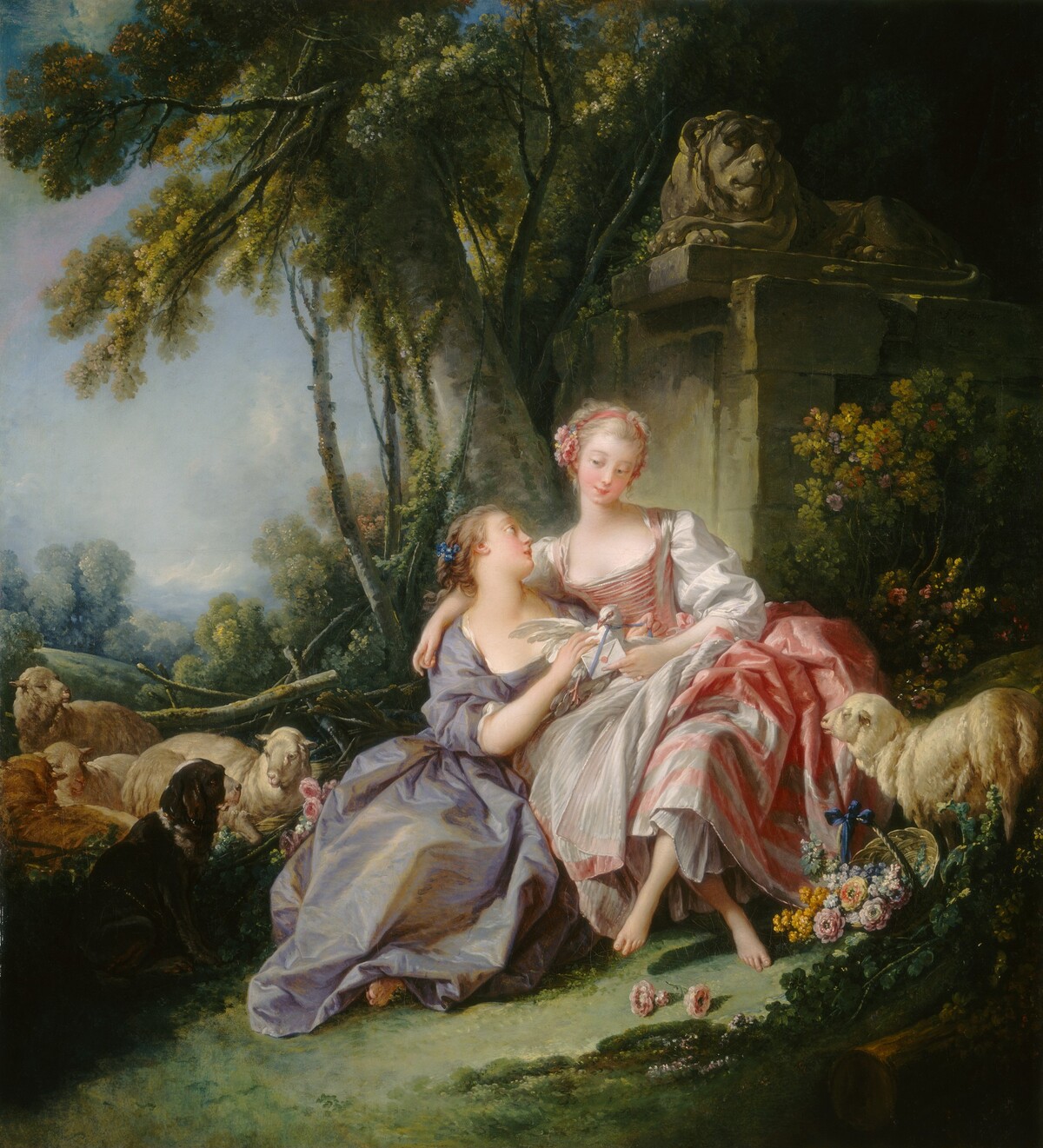
Boucher's The Love Letter (1750) captures a quintessential Rococo subject: a young woman in a pastoral setting, receiving or composing a letter of romantic significance. The painting exemplifies the fête galante tradition—aristocratic figures in idealized landscape settings engaged in the rituals of courtship—that Watteau invented and Boucher perfected with added sensuality. The letter itself is both the painting's narrative engine and its principal symbol: in 18th-century French culture, the love letter was the central instrument of aristocratic romance, a coded communication requiring skill, wit, and discretion. The painting's composition likely positions the woman within a lush garden or park setting, surrounded by the roses, columns, and statuary that signified cultivated nature. Boucher's technical handling is at its most seductive in such works: surfaces gleam, fabrics shimmer, skin glows with an artificial luminescence that makes the real world seem drab by comparison. Painted in 1750, this work belongs to the period when Boucher was at the height of his powers and influence, producing works that defined French aristocratic taste for a generation. The love letter subject also carried political implications: the elaborate social codes of aristocratic romance were themselves assertions of class identity, distinguishing those who had the leisure for such refinements from those who did not.
Cultural Impact
The Love Letter influenced the tradition of romantic genre painting that extended from 18th-century France through the Victorian era. Boucher's treatment—with its emphasis on the woman's emotional state rather than the letter's content—established a convention of depicting the moment of feeling rather than the narrative event. This convention influenced Fragonard, who pushed it further, and through Fragonard influenced Romantic painting and later cinema's treatment of romantic correspondence.
Why It Matters
This painting matters because it demonstrates how a seemingly trivial subject can carry rich cultural meaning. The love letter was not just personal communication but a social performance embedded in class codes, gender roles, and aesthetic conventions. Boucher's painting records all these dimensions while remaining, on the surface, a beautiful image of a young woman with a letter—a combination of depth and accessibility that defines great Rococo art.