Provenance
Recorded as from Massachusetts. (Mrs. Lillian Ullman, Tarrytown, New York), probably about 1940.[1] (M. Knoedler and Co., New York), by 1942; sold 1947 to Edgar William and Bernice Chrysler Garbisch; gift 1956 to NGA.
[1] Information on Ullman provided by Nina Fletcher Little, letters of 12 August 1968 and 30 September 1985, in NGA curatorial files.
Accession Number
1956.13.10
Medium
oil on wood
Dimensions
overall: 68.9 x 116.2 cm (27 1/8 x 45 3/4 in.) | framed: 82.8 x 131.1 x 4.4 cm (32 5/8 x 51 5/8 x 1 3/4 in.)
Classification
Painting
Credit Line
Gift of Edgar William and Bernice Chrysler Garbisch
Tags
Painting Neoclassical & Romantic (1751–1850) Oil Painting American
Background & Context
Background Story
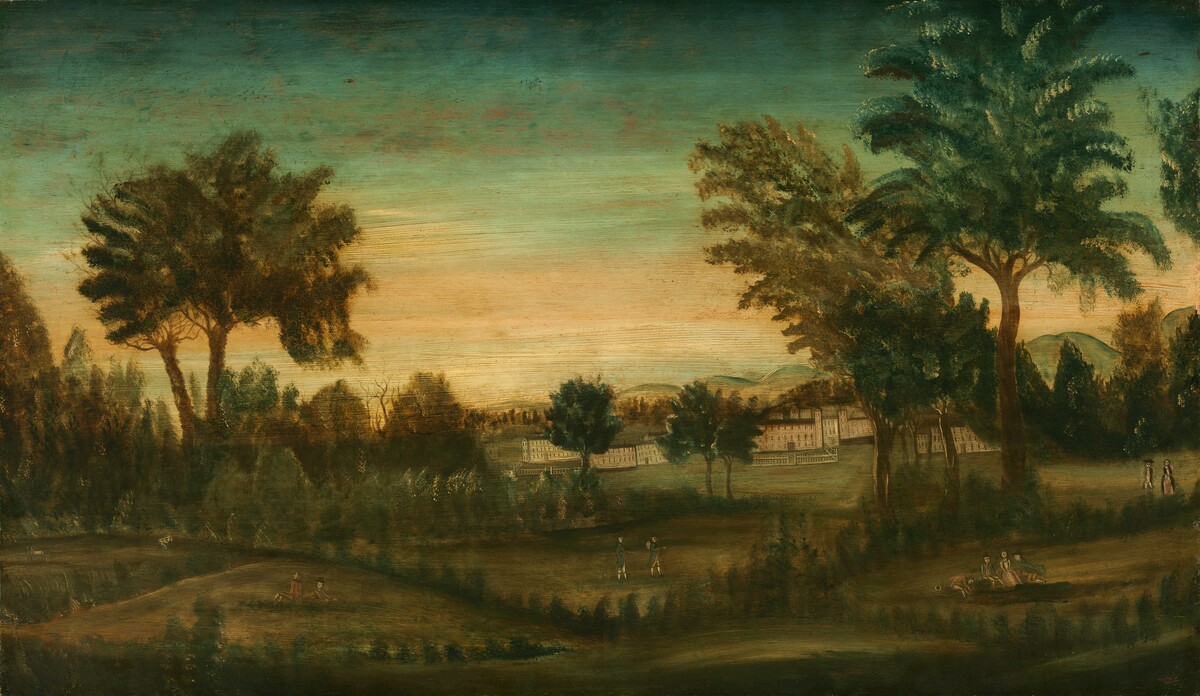
This small landscape painted on a wood panel is characteristic of the topographical tradition in early American art. The unknown artist depicts a cluster of buildings — likely a farmstead or small settlement — with the directness and specificity of a visual record rather than an artistic interpretation. The painting follows the conventions of European landscape painting at its most basic level — receding planes, a framing device of trees, and a sky that fills the upper portion — but the handling is entirely American in its lack of pretension. The buildings matter more than the picturesque effects.
Cultural Impact
Early American landscape painting served a documentary function that distinguished it from its European models. In a country still being settled and defined, a painting of a specific farmstead or settlement was both a property record and a cultural statement: we are here, we have built this, we belong to this place. Landscape with Buildings is not great art by European standards, and it does not try to be. It is an honest record of a specific place at a specific moment in American history.
Why It Matters
Landscape with Buildings is visual proof of the American impulse to record and claim — a small painting that says: this place exists, these buildings are here, and they are worth remembering.