Provenance
Recorded as from Connecticut. (Harry Shaw Newman, Old Print Shop, New York), by whom sold in 1948 to Edgar William and Bernice Chrysler Garbisch; gift to NGA, 1956.
Accession Number
1956.13.5
Medium
oil on canvas
Dimensions
overall: 115.6 x 70.2 cm (45 1/2 x 27 5/8 in.) | framed: 129.5 x 84.4 x 3.8 cm (51 x 33 1/4 x 1 1/2 in.)
Classification
Painting
Credit Line
Gift of Edgar William and Bernice Chrysler Garbisch
Tags
Painting Neoclassical & Romantic (1751–1850) Oil Painting Canvas American
Background & Context
Background Story
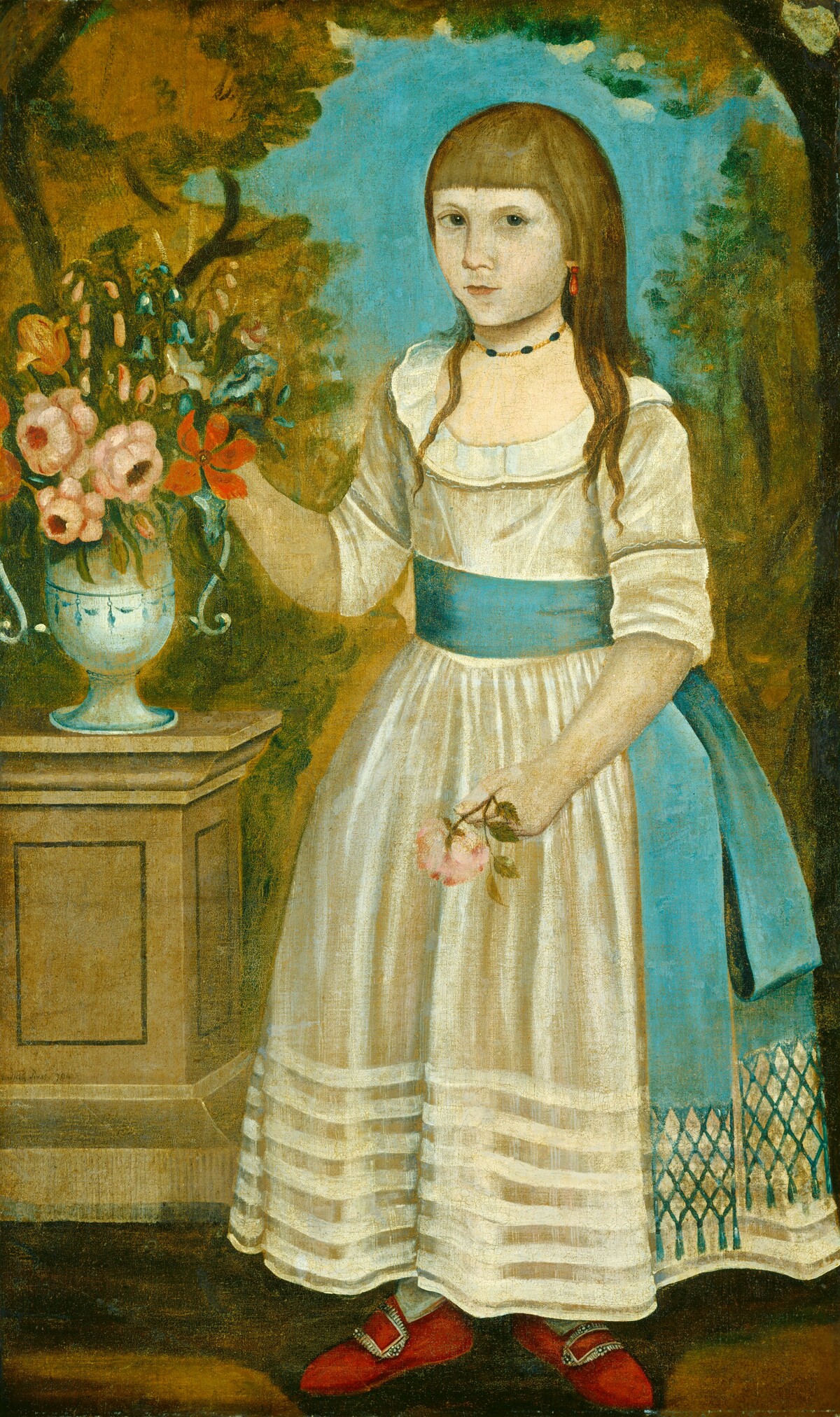
Catherine Brower is a portrait by MacKay dated 1791, depicting a woman during the early years of the American republic. The portrait belongs to the rich tradition of American portraiture that flourished in the decades following the Revolution, when the expanding middle class of the new nation sought to record their likenesses and assert their social standing through commissioned portraits. The year 1791 was a formative one for the young United States. The Constitution had been ratified only three years earlier, the first Congress was in session, and Americans were engaged in building the institutions of their new republic. In this context, portraiture carried particular significance as a means of asserting individual identity within the new political order. Unlike European aristocratic portraiture, which emphasized inherited rank and dynastic connections, American portraits of this period tended to emphasize the personal character and achievements of the sitter, reflecting the republican values that the new nation espoused. Catherine Brower, as the subject of a portrait commissioned in 1791, was likely a member of the prosperous middle class that was driving the young nation's economic and cultural development. The choice to commission a portrait was itself a statement of aspiration and self-regard that marked the sitter as a person of substance in a society where social standing was increasingly determined by visible markers of success rather than by birth alone. The artist MacKay worked within the conventions of late eighteenth-century American portraiture, which had been shaped by the work of provincial painters who adapted English and European portraiture traditions for American audiences. These artists developed a distinctive style that combined the dignity and formality of imported portrait conventions with a directness and honesty that American patrons preferred. The result was a body of work that, while sometimes lacking the technical polish of European court portraiture, conveyed the confidence and individuality of the new nation's citizens with remarkable force.
Cultural Impact
Early American portraits documented the faces and aspirations of the citizens who built the new republic, creating a visual record of the class of people—merchants, professionals, farmers, and their wives—whose enterprise and ambition were shaping the nation. These portraits also established conventions of American self-representation that emphasized individual achievement over inherited status, reflecting the democratic ideals of the new republic.
Why It Matters
This portrait matters as a document of early American identity and the role of portraiture in constructing social position in the post-Revolutionary period, recording the face of a citizen of the new republic at a moment when American society was defining itself through visual as well as political means.
![Saint Bernard and Saint Catherine of Alexandria with the Virgin of the Annunciation [right panel]](https://api.nga.gov/iiif/e6890364-4d99-4684-a62b-5060ee3c3446/full/400,/0/default.jpg)