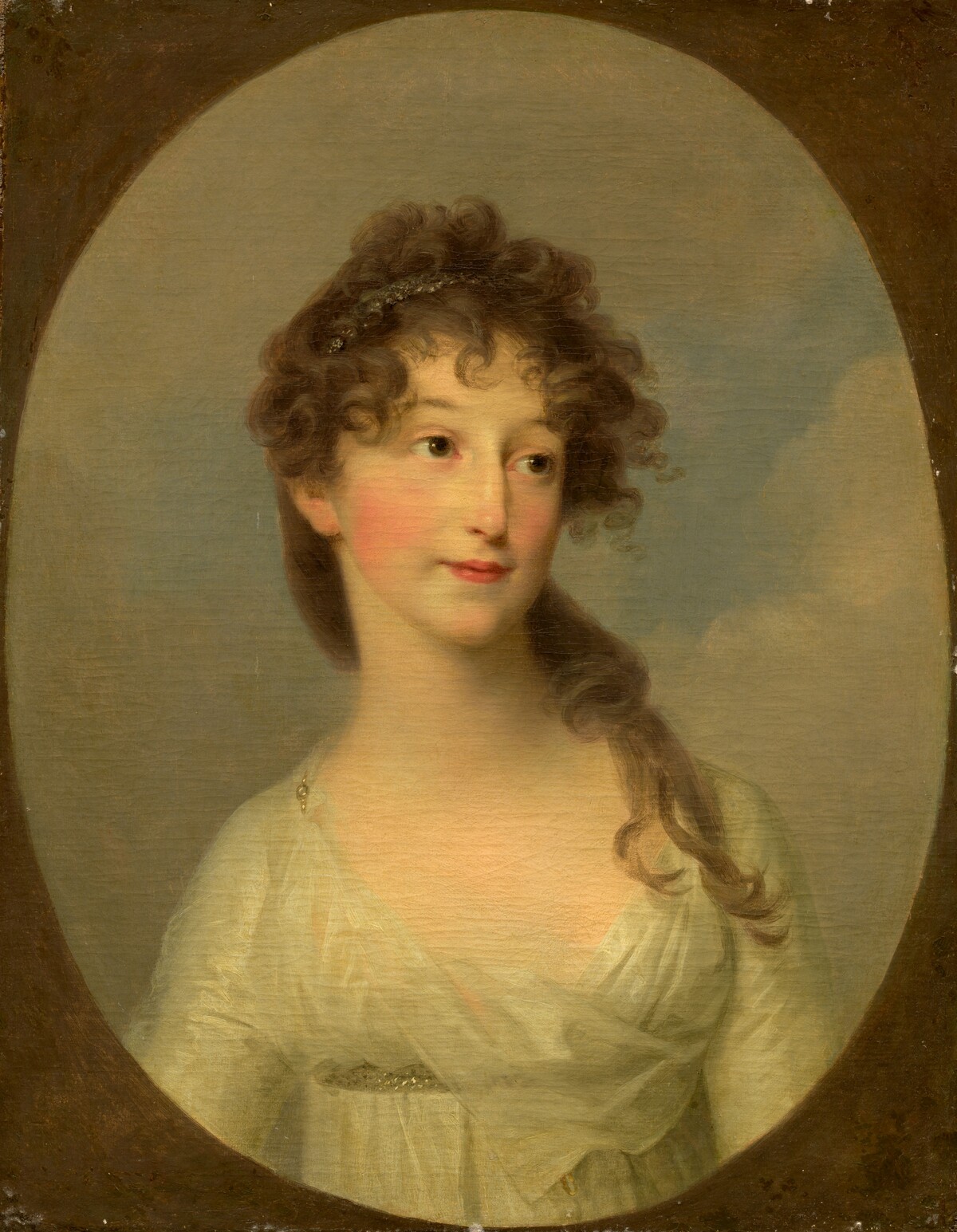
Provenance
By descent in the Krasinski Family, Saxony; sold 1889 to Mrs. George Rutledge Preston, New York;[1] by inheritance to her daughter, Alice Preston, London; gift 1954 to NGA.
[1] According to a 1 May 1954 letter from the donor to NGA director David Finley (in NGA curatorial files), her mother purchased the painting in June 1889 through the curator Theodor Schmidt of the Royal Dresden Gallery.
Accession Number
1954.5.1
Medium
oil on canvas
Dimensions
overall (painted oval): 62.9 x 49.5 cm (24 3/4 x 19 1/2 in.) | framed: 72.4 x 57.8 x 3.2 cm (28 1/2 x 22 3/4 x 1 1/4 in.)
Classification
Painting
Credit Line
Gift of Miss Alice Preston
Tags
Painting Neoclassical & Romantic (1751–1850) Oil Painting Canvas Swiss
Background & Context
Background Story
Angelica Kauffmann's "Possibly Franciska Krasinska, Duchess of Courland" (c. 1790) is a portrait of aristocratic elegance from one of the most successful women artists of the eighteenth century. The painting depicts its subject — tentatively identified as the Polish noblewoman Franciska Krasinska, who became Duchess of Courland through marriage — in the graceful, idealized manner that made Kauffmann the most sought-after portraitist of Neoclassical Europe.
Angelica Kauffmann (1741–1807) was a Swiss-Austrian painter who achieved extraordinary success in a male-dominated profession. She was a founding member of the Royal Academy in London (1768), one of only two women admitted at its founding, and enjoyed a pan-European career that took her from Rome to London to Venice and back. Her portraits and history paintings were commissioned by the most elite patrons of her era, including Catherine the Great of Russia and the Bavarian court. Joshua Reynolds, the president of the Royal Academy, held her in the highest esteem, and Goethe described her as "undoubtedly the most cultivated woman in Europe."
The portrait exemplifies Kauffmann's distinctive approach to female portraiture. Rather than the forthright naturalism of a Gainsborough or the psychological penetration of a Reynolds, Kauffmann painted her female subjects as embodiments of grace, intelligence, and virtue — qualities that Neoclassical culture associated with both women and the ancient world. The sitter's pose combines the relaxed informality of a private moment with the idealized dignity of a classical relief, creating an image that is simultaneously a portrait of a specific individual and an allegory of feminine refinement.
The painting's attribution of the sitter as Krasinska, Duchess of Courland, reflects the international scope of Kauffmann's career and the elite circles in which she moved. The Duchy of Courland — a Baltic territory now part of Latvia — was a small but wealthy state whose ruling family moved in the same cosmopolitan European society as Kauffmann's Italian and English patrons. The painting's date of c. 1790 places it in Kauffmann's Roman period, after she had permanently settled in Italy following her second marriage to the Venetian painter Antonio Zucchi. Rome in the 1790s was the center of the Neoclassical movement, and Kauffmann's studio on the Via Sistina was a gathering place for the international elite who came to Rome to study antiquity, commission art, and participate in the city's vibrant intellectual life.
Cultural Impact
As a founding member of London's Royal Academy and one of the few women to achieve international fame as a painter in the eighteenth century, Kauffmann broke barriers that had excluded women from the highest levels of the art profession for centuries.
Why It Matters
This portrait embodies Kauffmann's unique achievement — combining the grace and intelligence of her female subjects with the classical ideals of Neoclassicism, creating images of women that are simultaneously individualized and idealized.