Provenance
Probably commissioned c. 1518 by Alfonso I d'Este, Duke of Ferrara. Purchased from an unknown collector or dealer in Siena by Bertram Arthur Talbot, 17th Earl of Shrewsbury [d. 1856], Alton Towers, Stafford, England; (Shrewsbury sale, Christie & Manson, London, 4 July 1857, no. 151). Sir John Charles Robinson [1824-1913], London; sold 1868 to Sir Francis Cook, 1st Bt. [1817-1901], Doughty House, Richmond, Surrey;[1] by inheritance to his son, Sir Frederick Lucas Cook, 2nd Bt. [1844-1920], Doughty House; by inheritance to his son, Sir Herbert Frederick Cook, 3rd Bt. [1868-1939], Doughty House; by inheritance to his son, Sir Francis Ferdinand Maurice Cook, 4th Bt. [1907-1978], Doughty House, and Cothay Manor, Somerset;[2] (Francis A. Drey, London); sold February 1947 to the Samuel H. Kress Foundation, New York;[3] gift 1952 to NGA.
[1] The painting is included in Robinson's _Memoranda on Fifty Pictures_, London, 1868: no. 9. Most of the paintings described were sold to Cook the same year.
[2] The record of the sale to the Kress Foundation (see note 3) states that the painting is from "the collection of the late Sir Herbert Cook of Richmond (Surrey) England." The 4th Bt. inherited the collection and managed its dispersal after World War II with the trustees of the Cook estate.
[3] Drey sold five Cook paintings to the Kress Foundation, including the Sodoma (bill of sale dated 18 Feruary 1947; copy in NGA curatorial files). See also The Kress Collection Digital Archive, https://kress.nga.gov/Detail/objects/1820.
Accession Number
1952.5.76
Medium
oil on panel
Dimensions
overall: 137.8 x 97.6 cm (54 1/4 x 38 7/16 in.) | framed: 174.3 x 130.8 x 11.4 cm (68 5/8 x 51 1/2 x 4 1/2 in.)
Classification
Painting
Credit Line
Samuel H. Kress Collection
Tags
Painting Renaissance (1400–1599) Oil Painting Panel Painting Italian
Background & Context
Background Story
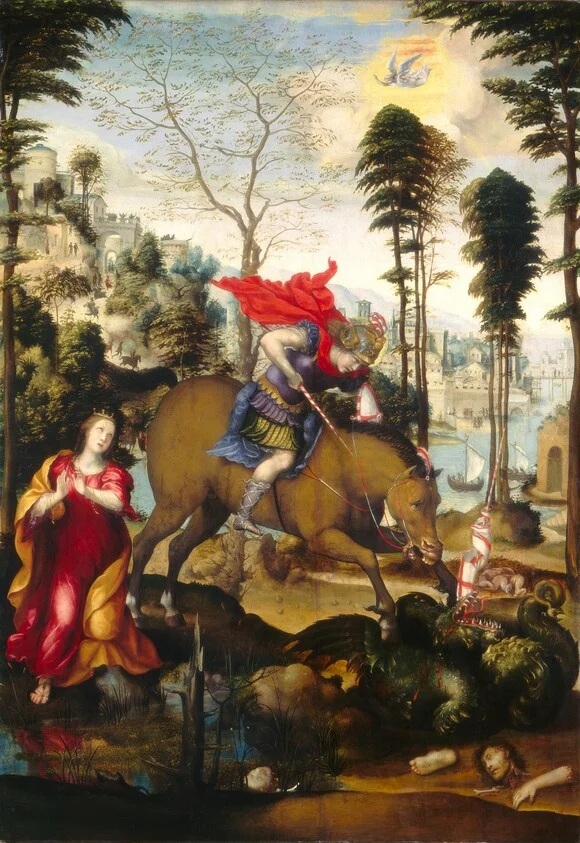
Sodoma (Giovanni Antonio Bazzi, 1477-1549) was a Sienese painter known for the combination of Sienese elegance and Roman monumentality that distinguishes his best work. Saint George and the Dragon from probably 1518 depicts the legendary episode in which Saint George slays the dragon in the elegant, mannered style that Sodoma developed under the influence of both the Sienese tradition and the Roman painting of Raphael and Michelangelo. The probably 1518 date places this in the period when Sodoma was working in Rome under the influence of the High Renaissance, after his Sienese training and before his return to Siena.
Cultural Impact
Saint George and the Dragon is important in Sodoma's oeuvre because it demonstrates the combination of Sianese elegance and Roman monumentality that distinguishes his best work. The probably 1518 painting shows Sodoma absorbing the High Renaissance manner of Raphael and Michelangelo while maintaining the Sienese elegance that distinguishes his work from the more austere Roman tradition, creating a type of painting that is simultaneously elegant and monumental.
Why It Matters
Saint George and the Dragon is Sodoma's Sienese elegance meets Roman monumentality: the legendary episode rendered with the combination of Sienese grace and High Renaissance grandeur that distinguishes his best work. The probably 1518 painting shows the Sienese painter absorbing the Roman manner of Raphael and Michelangelo.
![Saint Bernard and Saint Catherine of Alexandria with the Virgin of the Annunciation [right panel]](https://api.nga.gov/iiif/e6890364-4d99-4684-a62b-5060ee3c3446/full/400,/0/default.jpg)