Provenance
Acquired from the artist by Prince Joseph Wenzel of Liechtenstein [1696-1772], Austrian ambassador to France, 1737-1741; by descent through the Princes of Liechtenstein to Prince Franz Josef II von und zu Liechtenstein [1906-1989], Vienna and later Vaduz, until at least 1948; (Frederick Mont, Inc., New York); purchased 1 November 1950 by the Samuel H. Kress Foundation, New York;[1] gift 1952 to NGA.
[1] The invoice from Frederick Mont to the Kress Foundation is dated 1 November 1950 (copy in NGA curatorial files, see also The Kress Collection Digital Archive, https://kress.nga.gov/Detail/objects/2078.).
Accession Number
1952.5.37
Medium
oil on canvas
Dimensions
overall: 46.2 x 37 cm (18 3/16 x 14 9/16 in.) | framed: 61.9 x 53.7 x 7.3 cm (24 3/8 x 21 1/8 x 2 7/8 in.)
Classification
Painting
Credit Line
Samuel H. Kress Collection
Tags
Painting Baroque (1600–1750) Oil Painting Canvas French
Background & Context
Background Story
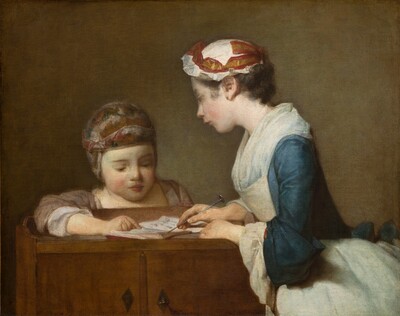
The Attentive Nurse (also known as The Hardworking Mother) is one of Chardin's most celebrated genre scenes, exhibited at the Salon of 1747 to widespread acclaim. A nurse or mother sits absorbed in her work, preparing a meal while a child watches from the side. The composition is deceptively simple: a single figure, a domestic interior, an everyday task. But Chardin's handling transforms the ordinary into the monumental. The nurse's concentrated attention, the warm light falling on her cap and apron, and the careful arrangement of kitchen objects all elevate the scene to the dignity of serious art.
Cultural Impact
Chardin was the 18th-century painter who most convincingly argued that genre painting — scenes of ordinary life — deserved the same respect as history painting. The Attentive Nurse is his manifesto: a kitchen scene treated with the compositional rigor and emotional seriousness that academic theory reserved for mythological and religious subjects. Diderot, Chardin's greatest champion, wrote that one needed a magnifying glass to appreciate the painting's detail and distance oneself to feel its full effect.
Why It Matters
The Attentive Nurse proved that the highest art could be made from the humblest subject. This single painting did more to legitimize genre painting than any theoretical argument, and its influence echoes through every subsequent artist who found beauty in the ordinary.