Provenance
Possibly (Wildenstein & Co., Paris, New York, and London);[1] David David-Weill [1871-1952], Neuilly-sur-Seine, France, by 1925;[2] purchased February/March 1937 with the David-Weill collection by (Wildenstein & Co., Paris, New York, and London);[3] sold 1946 to the Samuel H. Kress Foundation, New York;[4] gift 1952 to NGA.
[1] Eisler 1977: 314 indicates that David-Weill acquired the painting from Wildenstein, whose Paris office no longer has records to confirm this transaction (see letter from Ay-Whang Hsia to David Rust, 8 August 1978, in NGA curatorial files).
[2] The painting appears in the background of a portrait of David-Weill painted by Edouard Vuillard in 1925, and was catalogued in the David-Weill collection by Georges Henriot in 1926.
[3] "Sale of the David-Weill Collection." _Art News_ 35 (27 February 1937): 12 and "David-Weill Pictures Come to New York." _Art Digest_ 12 (1 November 1937): 13. David-Weill, head of Lazard Frère Bank and Chairman of the Conseil des Musées de France, had an extraordinary collection of art which was dispersed in several ways during the World War II era. Some of the collection was consigned to Wildenstein's in London, who in turn sent some of the paintings, including this Chardin, to their New York branch where they were exhibited in 1937. Despite complications of nationality during the war, David-Weill managed to ship a large part of the collection via Lisbon to New York. Unfortunately another portion of the collection, which had been safeguarded in Sourches by French museum administration officials, was confiscated by the Nazis in July 1941. Much of the collection was recovered and processed through the Munich Central Collecting Point after the war by the Allies.
[4] See The Kress Collection Digital Archive, https://kress.nga.gov/Detail/objects/2017.
Accession Number
1952.5.36
Medium
oil on canvas
Dimensions
overall: 49.6 x 59.4 cm (19 1/2 x 23 3/8 in.) | framed: 72.2 x 82.1 x 8.3 cm (28 7/16 x 32 5/16 x 3 1/4 in.)
Classification
Painting
Credit Line
Samuel H. Kress Collection
Tags
Painting Baroque (1600–1750) Oil Painting Canvas French
Background & Context
Background Story
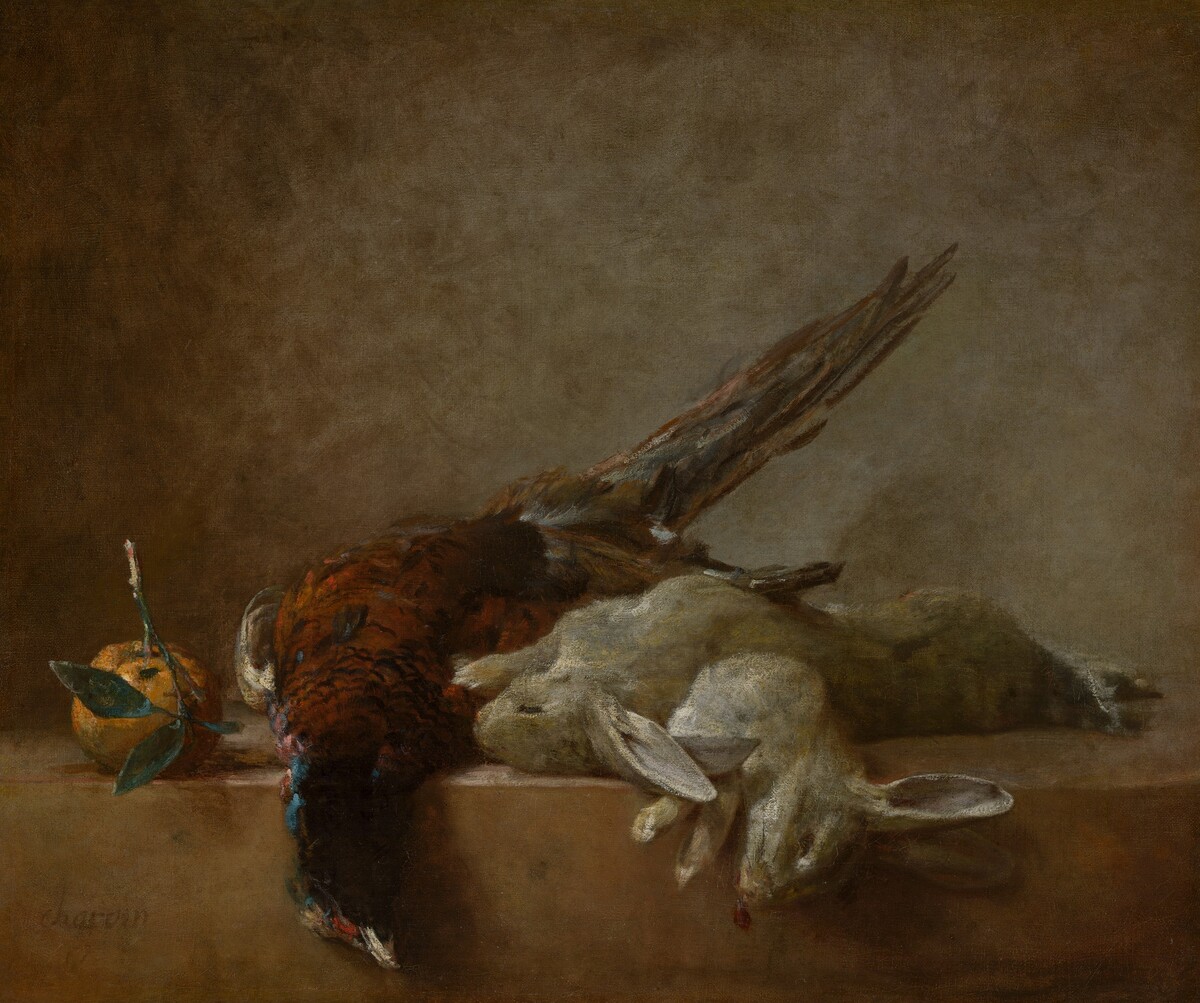
Chardin's late still lifes of game — dead hares, pheasants, and other spoils of the hunt — are among his most affecting works. Where his earlier kitchen still lifes celebrate abundance and domestic order, these paintings confront mortality directly. The game animals lie limp and lifeless, their fur and feathers rendered with the same tactile precision that Chardin brought to copper pots and earthenware. There is no sentimentality, no moralizing — just the plain, physical fact of death, observed with an artist's eye for the beauty that persists even in stillness.
Cultural Impact
Chardin's game still lifes belong to a tradition stretching from the Netherlandish painters of the 16th century through the Spanish bodegón. But where those painters loaded their game pieces with vanitas symbolism and moral messages, Chardin simply looks. The result is paradoxically more moving: by refusing to moralize, he allows the viewer to confront mortality without the mediation of allegory.
Why It Matters
Still Life with Game is Chardin at his most philosophical without being philosophical at all. He paints what he sees, and what he sees is that beauty and death coexist in the same object, requiring no commentary.