Provenance
Stefano Bardini [1836-1922], Florence, by 1899; (Bardini sale, Christie, Manson & Woods, London, 5 June 1899, no. 494, bought in); (Bardini sale, American Art Association, New York, 25 April 1918, no. 468);[1] purchased by H.L. Kaufman; (Pinakos, Inc. [Rudolf Heinemann], New York); on joint account 1942 with (Frederick Mont), (Victor D. Spark, New York) and (M. Knoedler & Co, London, New York and Paris, France);[2] sold 6 August 1943 to the Samuel H. Kress Foundation, New York;[3] gift 1952 to NGA.
[1] This information comes from the M. Knoedler & Co. précis in NGA curatorial files.
[2] Victor D. Spark papers, Archives of American Art, Box 3 (copy in NGA curatorial files). See also M. Knoedler & Co. Records, accession number 2012.M.54, Research Library, Getty Research Institute, Los Angeles: Stockbook no. 8, p. 218 (copy in NGA curatorial files).
[3] See The Kress Collection Digital Archive, https://kress.nga.gov/Detail/objects/2183.
Accession Number
1952.5.4
Medium
oil on panel
Dimensions
overall: 111.8 x 95.3 cm (44 x 37 1/2 in.) | framed: 141 x 123.2 x 8.3 cm (55 1/2 x 48 1/2 x 3 1/4 in.)
Classification
Painting
Credit Line
Samuel H. Kress Collection
Tags
Painting Renaissance (1400–1599) Oil Painting Panel Painting Italian
Background & Context
Background Story
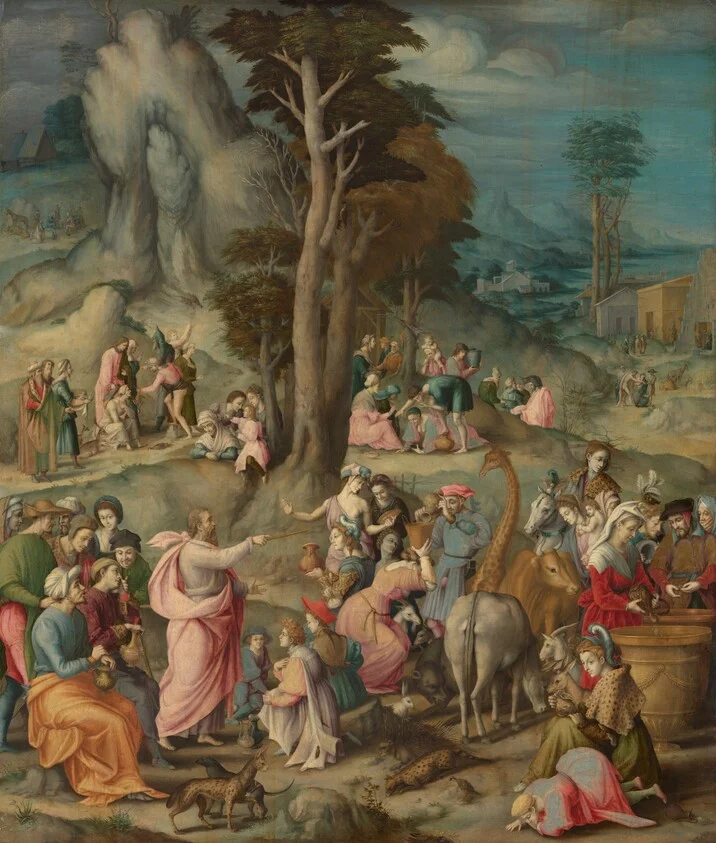
Bachiacca's "The Gathering of Manna" (1540/1555) depicts the biblical episode from Exodus 16 in which God provides the Israelites with manna — a miraculous bread-like substance — during their forty-year wandering in the desert after the Exodus from Egypt. The painting shows the Israelites collecting the manna that has fallen from heaven, some gathering it eagerly, others looking heavenward in gratitude, in a composition that combines narrative detail with decorative richness.
Bachiacca (1494–1557), whose real name was Francesco d'Ubertino Verdi, was a Florentine painter whose eclecticism and decorative skill made him a favorite of the Medici court. His nickname, derived from "bacca" (a type of silk fabric), may reflect this decorative sensibility or his family's involvement in the textile trade. Bachiacca was a highly versatile painter who absorbed influences from virtually every major Florentine artist of his generation — including Andrea del Sarto, Pontormo, Bronzino, and Francesco Salviati — producing works that synthesize these diverse influences into a distinctive style characterized by rich color, intricate detail, and an almost obsessive attention to ornamental pattern.
The subject of the Gathering of Manna was a popular one in sixteenth-century Florence, where it resonated with both religious meaning and contemporary political symbolism. Theologically, the manna represented God's providential care for his chosen people, a theme with obvious relevance to a city that saw itself as a new Israel. Politically, the Medici dukes who ruled Florence after 1530 frequently commissioned images of divine provision to legitimize their own rule — suggesting that just as God had fed the Israelites in the wilderness, so the Medici provided for Florence in times of need.
Bachiacca's treatment of the subject is notable for its combination of grand narrative gestures and intimate decorative detail. The foreground is filled with figures arranging the manna, carrying vessels, and distributing the miraculous food, rendered in Bachiacca's characteristically precise technique. The landscape stretches away to a distant horizon, providing the spatial depth that sixteenth-century viewers expected from history painting, while the sky — from which the manna descends — is treated with a particularly rich and luminous color that marks the divine intervention.
Bachiacca also produced designs for tapestries, and his painting style reflects this practice: the detailed patterns on the figures' clothing, the ornamental borders, and the overall sense of a surface richly decorated rather than simply depicted all echo the textile traditions in which he worked. This decorative quality — sometimes dismissed by later critics as mannered or excessive — is now recognized as an intentional artistic strategy that connected painting to the broader visual culture of the Medici court, where textiles, ceramics, and metalwork were as highly valued as paintings and sculpture.
Cultural Impact
Bachiacca's Medici commissions demonstrate the role of art in reinforcing ducal authority in sixteenth-century Florence, using biblical narratives of divine provision as metaphors for Medici governance.
Why It Matters
This painting combines Florentine narrative painting with the decorative richness of textile design — a biblical subject transformed into a courtly spectacle that served both religious devotion and Medici political symbolism.