Provenance
Private collection, Brussels. (Robert Frank, London, by 1935);[1] on consigment from 1937 with (M. Knoedler & Co., New York; joint purchase 1945 with (Pinakos [Rudolf Heinemann);[2] purchased 1950 by the Samuel H. Kress Foundation, New York;[3] gift 1952 by exchange to NGA.
[1] The corresponding entry in _Exposition Universelle et Internationale de Bruxelles. Cinq Siècles d'Art_ (Brussels, 1935, no. 151, as Pieter Brueghel the Elder) states that before being acquired by Frank, the painting was in Brussels in the collection of an unnamed aristocrat. On the reverse are: an illegible stamp, possibly an Austrian customs stamp; a paper sticker, "Cinq Siècles d'Art (Bruxelles 1935)"; and a paper sticker, "Exposition De Van Eyck."
[2] Knoedler commission book no. 3, p. 87, stock book no. 9, p. 96, and sales book no. 16, p. 251, no. A3127, M. Knoedler & Co. Records, Getty Research Institute copies NGA curatorial files).
[3] Both The Baltimore Museum of Art, _An Exhibition of Paintings by Living Masters of the Past_, 1943, no. 9; and Colin Eisler, _Paintings from the Samuel H. Kress Collection: European Schools Excluding Italian_, Oxford, 1977, p. 95; list Countess Montblanc, Belgium, as owner of the painting, but this is otherwise unverified. See also The Kress Collection Digital Archive, https://kress.nga.gov/Detail/objects/2303.
Accession Number
1952.2.19
Medium
oil on panel
Dimensions
overall: 58.5 x 85.7 cm (23 1/16 x 33 3/4 in.) | framed: 77.8 x 104.8 x 7.6 cm (30 5/8 x 41 1/4 x 3 in.)
Classification
Painting
Credit Line
Samuel H. Kress Collection
Tags
Painting Renaissance (1400–1599) Oil Painting Panel Painting
Background & Context
Background Story
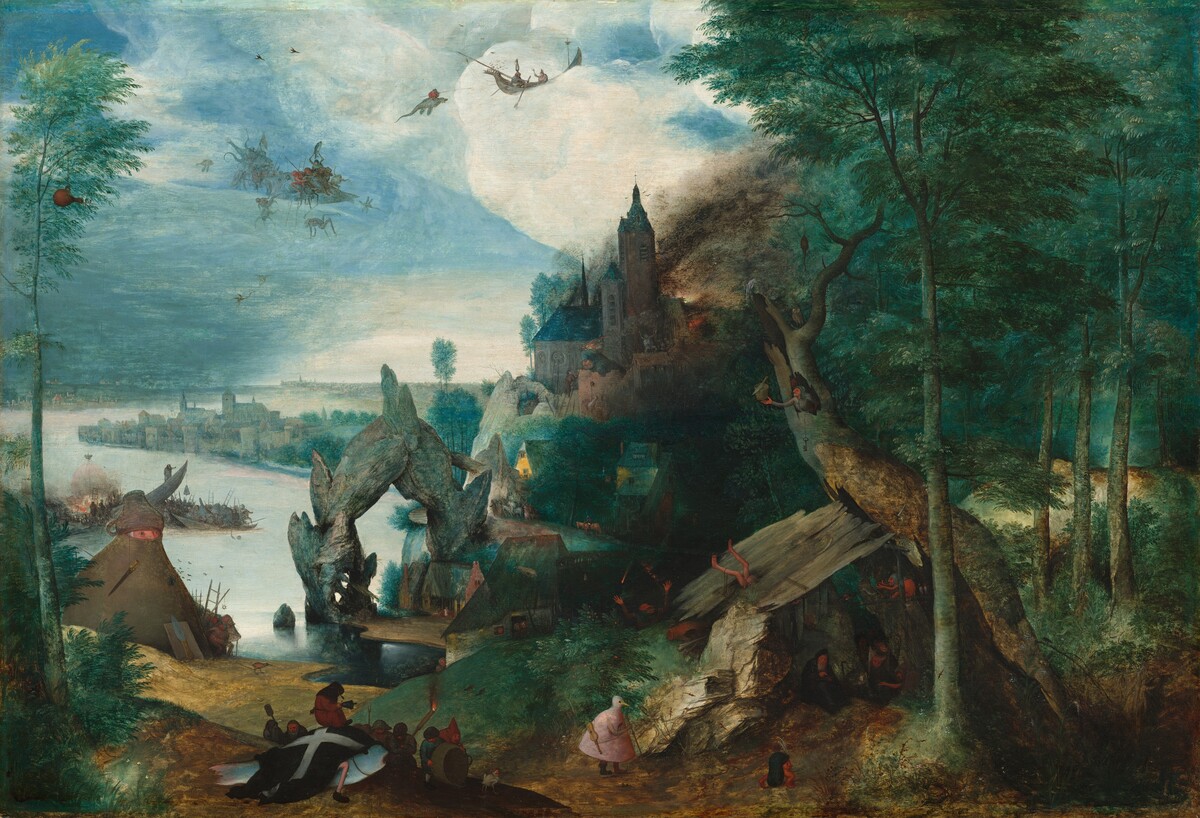
The Temptation of Saint Anthony from c. 1550-75 is attributed to a follower of Pieter Bruegel the Elder (c. 1525-1569), the Flemish painter known for his landscape and genre scenes that combine Netherlandish tradition with the fantastical imagery of Hieronymus Bosch. The Temptation of Saint Anthony—the desert father tempted by demons in the wilderness—was a subject that Bruegel and his followers treated with the fantastical imagery of Bosch, whose infernal landscapes had defined the subject for Netherlandish painting. The 'follower of' attribution indicates that this painting was produced by an artist working in Bruegel's manner.
Cultural Impact
The Temptation of Saint Anthony is important in the history of Netherlandish painting because it demonstrates the Bruegel tradition of fantastical religious imagery that descended from Bosch. The 'follower of' attribution shows that Bruegel's manner of combining landscape detail with fantastical imagery was widely imitated by artists who served the market for infernal and fantastical subjects that Bosch had created and Bruegel had continued.
Why It Matters
The Temptation of Saint Anthony is the Bruegel-Bosch tradition of fantastical religious imagery: Saint Anthony tempted by demons in the wilderness, rendered in the manner of Bruegel's followers who continued the infernal landscape tradition that Bosch created. The c. 1550-75 painting demonstrates the wide demand for fantastical religious subjects in Netherlandish painting.