Provenance
Possibly William Wethered [d. 1863], King's Lynn, Norfolk, and, by 1849, London.[1] John Chapman [1810-1877], Hill End, Cheshire, and Carlecotes, Yorkshire, by 1852;[2] by descent to his son, Edward Chapman [1839-1906]. (Arthur J. Sulley & Co.), London, in joint ownership with (Thos. Agnew & Co.), London; purchased 1912 from (Arthur J. Sulley & Co.), New York, by Watson B. Dickerman [1846-1923]; passed to his wife, Florence E. Dickerman, New York; gift to NGA, 1951.
[1] The evidence for Wethered's possible ownership of the picture is discussed in Martin Butlin and Evelyn Joll, _The Paintings of J.M.W. Turner_, 2d rev. ed., 2 vols., (New Haven and London, 1984), I: 232. [2] According to a note in the copy of the Royal Academy catalogue of 1839, in Agnew's library (Butlin and Joll, per note 1 above).
Accession Number
1951.18.1
Medium
oil on canvas
Dimensions
overall: 92.6 x 123.7 cm (36 7/16 x 48 11/16 in.) | framed: 124.1 x 154.9 x 10.1 cm (48 7/8 x 61 x 4 in.)
Classification
Painting
Credit Line
Gift of Mrs. Watson B. Dickerman
Tags
Painting Neoclassical & Romantic (1751–1850) Oil Painting Canvas British
Background & Context
Background Story
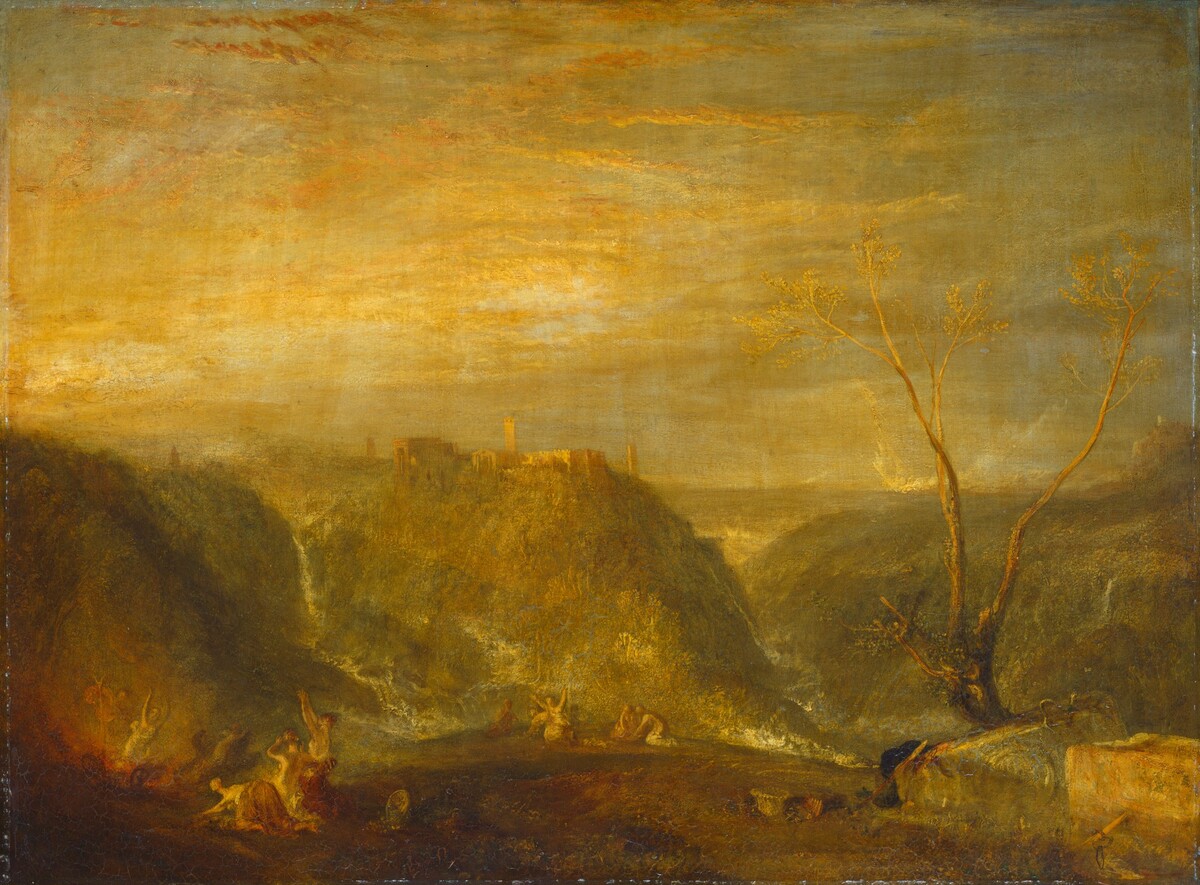
Turner's late mythological paintings pushed beyond narrative into pure atmospheric sensation, and The Rape of Proserpine (1839) is a perfect example. The subject comes from Ovid: Pluto, god of the underworld, seizes Proserpine and drags her to Hades while her mother Ceres searches the earth in vain. But in Turner's hands, the story dissolves into swirling gold, crimson, and shadow. The figures are barely discernible — tiny forms nearly swallowed by the infernal glow of the landscape. This was Turner at his most radical, painting mythology not as illustration but as emotional experience.
Cultural Impact
The painting demonstrates Turner's evolution from the topographical precision of his early career to the near-abstract colorism that scandalized Victorian critics. Where earlier artists depicted the rape as drama — Pluto's chariot, Proserpine's terror, the nymphs' alarm — Turner made the landscape itself the protagonist. The volcanic light, the churning terrain, and the dissolving horizons all enact the violence of abduction at the level of pure feeling. This approach directly prefigured Abstract Expressionism by nearly a century.
Why It Matters
Turner's mythological phase represents his most daring break with convention. These paintings were routinely mocked as 'pictures of nothing' when exhibited, yet they opened the door for everything that followed in modern art — from Impressionism's dissolution of form to Rothko's color fields.