Provenance
Gottlieb Friedrich Reber [1880-1959], Lausanne, in 1926.[1] (Paul Rosenberg & Co., Paris); sold 15 May 1930 to Chester Dale [1883-1962], New York;[2] bequest 1963 to NGA.
[1] Reproduced as in the Reber collection in _Der Querschnitt_, Jahrgang VI, Heft 4 (April 1926). See Christian Geelhaar, _Picasso. Wegbereiter und Förderer seines Aufsteigs 1899-1939_, Zurich, 1993: 160. The Dale collection inventory, copy in NGA curatorial files, gives the painting's history as "Bought by Mr. Rosenberg from the artist."
[2] The receipt from Rosenberg is in NGA curatorial files.
Accession Number
1963.10.195
Medium
oil on canvas
Dimensions
overall: 97.2 x 130.2 cm (38 1/4 x 51 1/4 in.) | framed: 134 x 167 x 8.2 cm (52 3/4 x 65 3/4 x 3 1/4 in.)
Classification
Painting
Credit Line
Chester Dale Collection
Tags
Painting Early Modern (1901–1950) Oil Painting Canvas Spanish
Background & Context
Background Story
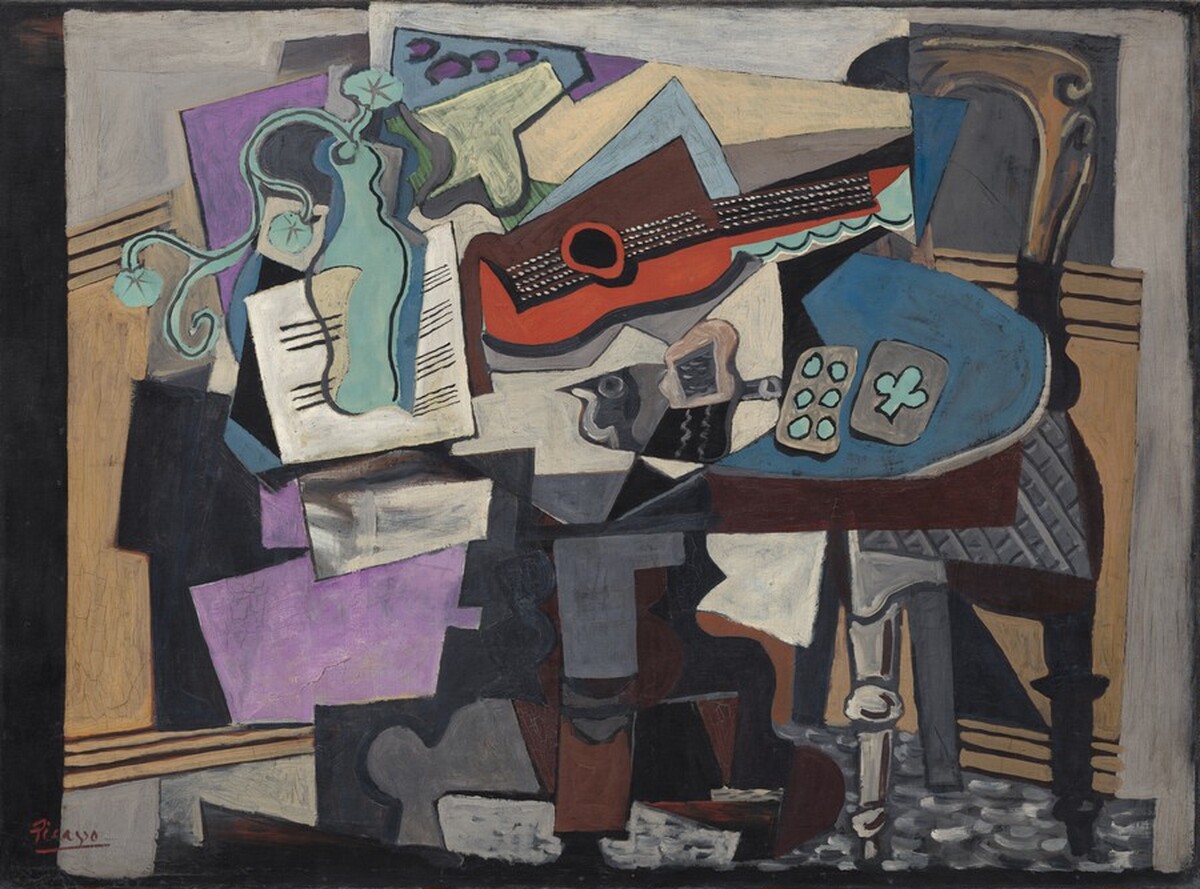
Still Life (1918) belongs to the period immediately after World War I, when Picasso was reconsidering the artistic direction that Cubism had established. The year 1918 was pivotal: the war's end, Picasso's marriage to Olga Khokhlova, and his growing wealth and social status were transforming his life and, inevitably, his art. This still life, painted during this transitional moment, likely reflects the tension between the Cubist innovation of the pre-war years and the Neoclassical tendencies that would dominate the early 1920s. Picasso's still-life painting had been central to Cubism's development—the genre's simple objects (guitars, bottles, glasses) had provided the subjects for the movement's most radical experiments in form and representation. This 1918 still life may return to these familiar objects with a new approach: the shattered planes of Analytic Cubism are giving way to more ordered compositions, and the fractured representation of pre-war work is being replaced by more legible forms. The painting thus represents a moment of balance—the point where Cubist complexity and Neoclassical order exist in equilibrium rather than opposition. This equilibrium would not last: by 1921, Picasso's Neoclassical style would dominate, and the Cubist still life would become a historical rather than a current practice.
Cultural Impact
Picasso's transitional still-life paintings influenced how the relationship between Cubism and Neoclassicism was understood, documenting the moment when one style gave way to another. The paintings influenced later artists who similarly sought to balance innovation and tradition within their work. The 1918 still life also influenced how World War I's impact on artistic development was understood, connecting stylistic change to historical transformation.
Why It Matters
This painting matters because it captures a pivotal moment in Picasso's career—the point where Cubism's revolutionary energy began to give way to the Neoclassical order that would dominate the 1920s. The still life, with its simple objects rendered in a balance of complexity and legibility, represents the artist at a crossroads, choosing between the style that made him revolutionary and the style that would make him respectable.