Provenance
Purchased 1908 from the artist by André Level, Paris, for the collection of La Peau de l'Ours;[1] (their sale, Hôtel Drouot, Paris, 2 March 1914, no. 63, as _Les bateleurs_); purchased by (Modernen Galerie Heinrich Thannhauser, Munich); sold between November 1914 and June 1915 to Hertha Koenig [1884-1976], Munich.[2] (Valentine Gallery, New York); sold 10 February 1931 to Chester Dale [1883-1962], New York;[3] bequest 1963 to NGA.
[1] A letter from Level to Picasso dated 24 January 1908 in the Musée Picasso confirms a studio visit at that time (copy in NGA curatorial files; see also email from Annie Cohen Solal dated 4 October 2021). The purchase of the painting is described in André Level, _Souvenirs d'un collectionneur_. Paris, 1959: 23.
[2] The fifth _Elegy_ by the German author Rainer Maria Rilke is dedicated to his friend and the owner of the painting, Hertha Koenig, a poet and promoter of art and artists. In November 1914, Rilke wrote to her that he had seen the painting at Thannhauser. In June 1915, while he was living in Munich and finding it difficult to obtain suitable lodgings, Rilke asked Koenig whether, while she and her family were in the country, he might live for a while in her house, and enjoy the privilege of living beside "the great Picasso." His request was granted, and he lived there from June until October. On June 28, in a letter to Thankmar Freiherr von Münchhausen, Rilke wrote that he was "sitting here in the apartment of friends...with the finest Picasso (the 'Saltimbanques'), in which there is so much Paris that, for the moment, I forget." (_Wartime Letters of Rainer Maria Rilke 1914-1921_, translated by M.D. Herter Norton, New York, 1940: 29-30). See also _Rainer Maria Rilke: Duino Elegies. The German Text, with an English Translation, Introduction, and Commentary by J.B. Leishman and Stephen Spender_, New York, 1939: 101-102.
[3] For Chester Dale's account of his acquisition of this painting from a bank in Switzerland, through Valentine Dudensing, see Dale's unpublished autobiography, Archives of American Art, microfilm reel #3969 (copies NGA curatorial files).
Accession Number
1963.10.190
Medium
oil on canvas
Dimensions
overall: 212.8 x 229.6 cm (83 3/4 x 90 3/8 in.) | framed: 240.4 x 256.3 cm (94 5/8 x 100 7/8 in.)
Classification
Painting
Credit Line
Chester Dale Collection
Tags
Painting Early Modern (1901–1950) Oil Painting Canvas Spanish
Background & Context
Background Story
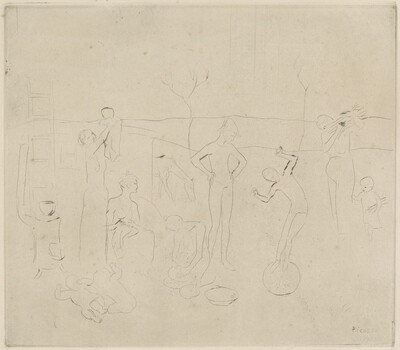
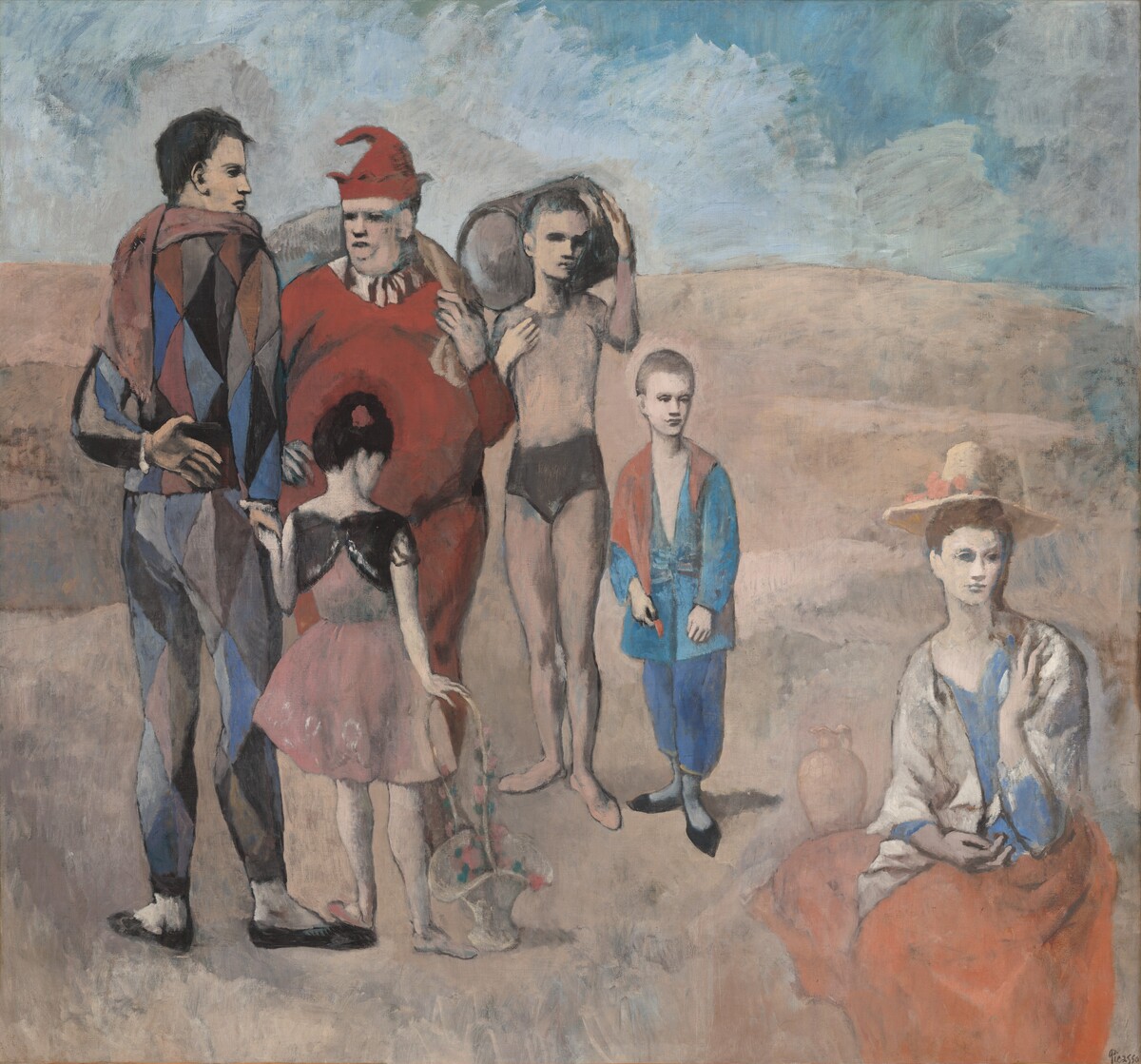
Family of Saltimbanques is the largest and most ambitious painting of Picasso's Rose Period (1904-1906). It depicts a troupe of itinerant performers - a harlequin, two acrobats, a girl carrying a basket, and a dwarf - standing in a desolate landscape. None of them interact; each figure exists in isolated contemplation, creating an atmosphere of melancholy that transcends the cheerful associations of circus life.
Picasso identified deeply with the saltimbanques - traveling entertainers who lived outside conventional society. As a young, penniless Spanish immigrant in Paris, he saw himself as a kind of harlequin: an outsider whose survival depended on his ability to perform. The harlequin, standing slightly apart, is widely read as a self-portrait.
The painting underwent at least four compositional revisions. X-ray analysis reveals that Picasso originally included a mother and child and a traveling coach, gradually stripping away narrative elements until only the isolated figures remained.
Cultural Impact
The figure of the harlequin - the sensitive outsider trapped between belonging and alienation - became a recurring motif in Picasso's work and in 20th-century art broadly. The saltimbanques influenced poets like Rilke and philosophers like Bakhtin, who saw in the circus performer a metaphor for the modern artist's condition.
Why It Matters
This painting marks Picasso's transition from the personal grief of the Blue Period to a broader meditation on artistic identity. It is the first major work in which Picasso explicitly addresses whether the artist is a performer, an outsider, or both.