Provenance
Purchased from the artist by Yvon Helft, Paris.[1] (Paul P. Rosenberg et Cie., Paris); sold 5 June 1930 to Chester Dale [1883-1962], New York; bequest 1963 to NGA.
[1] Provenance compiled from information in NGA curatorial records.
Accession Number
1963.10.189
Medium
oil on canvas
Dimensions
overall: 61 x 50.2 cm (24 x 19 3/4 in.) | framed: 82.5 x 72 x 6.3 cm (32 1/2 x 28 3/8 x 2 1/2 in.)
Classification
Painting
Credit Line
Chester Dale Collection
Tags
Painting Early Modern (1901–1950) Oil Painting Canvas Spanish
Background & Context
Background Story
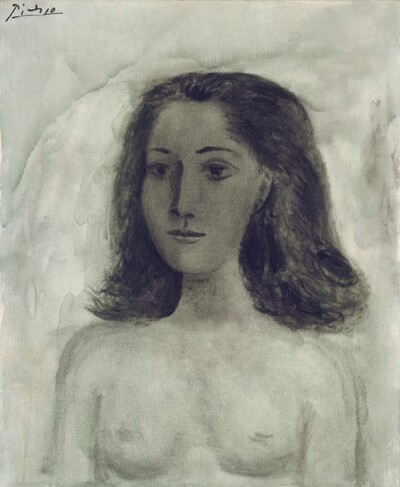
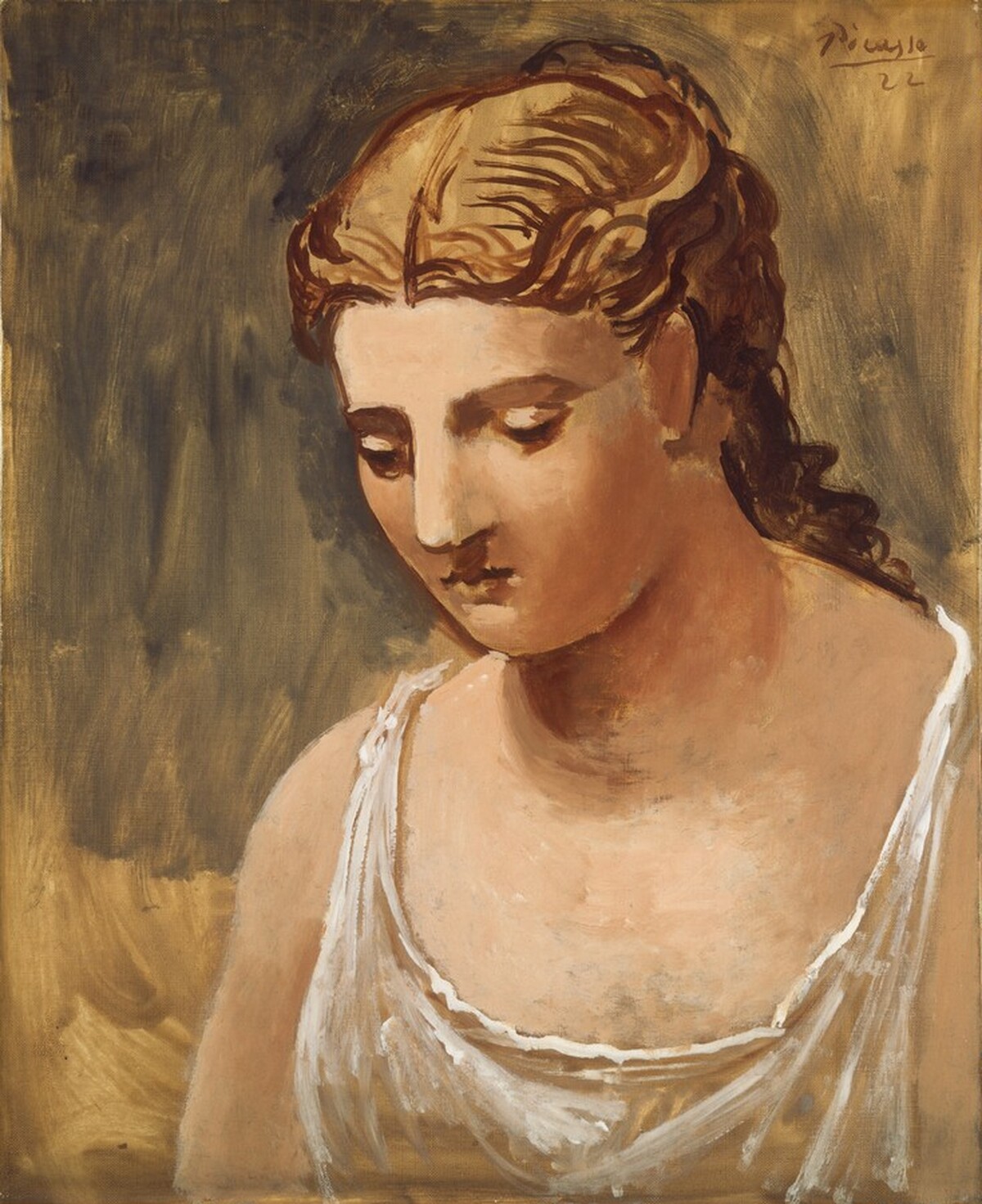
Classical Head (1922) belongs to Picasso's Neoclassical period—the return to ordered, monumental form that characterized his work after the disruptions of World War I and the explorations of Synthetic Cubism. By 1922, Picasso was painting figures and heads that referenced Greco-Roman sculpture, Renaissance portraiture, and the Ingres tradition of linear refinement—references that seemed to reject the Cubist revolution he had led. The classical head, with its simplified features, serene expression, and sculptural volume, represents Picasso's engagement with the European tradition that his pre-war work had seemed to destroy. But this return to classicism was not a retreat: it was a demonstration that Picasso could work in any style he chose, and that the same formal intelligence that had deconstructed reality in Cubism could reconstruct it in classicism. The year 1922 was the midpoint of Picasso's Neoclassical phase, and the Classical Head represents the style at its most resolved: the features are simplified but not abstracted, the expression is serene but not vacuous, and the technique combines sculptural volume with linear refinement. The painting's title—Classical Head—announces its program: this is Picasso working in the classical tradition, producing art that can be measured against the European canon rather than only against modernism's innovations.
Cultural Impact
Picasso's Neoclassical works influenced the return to order in 1920s European art, demonstrating that modernism could engage with tradition rather than merely reject it. The paintings influenced later artists who similarly returned to classical forms after periods of innovation, establishing a model of cyclical artistic development. The Classical Head specifically influenced how portrait sculpture was understood in modern art, connecting painting to three-dimensional form.
Why It Matters
This painting matters because it demonstrates that Picasso's genius was not limited to innovation—he could also reconstruct what he had deconstructed. The Classical Head, with its serene beauty and formal mastery, argues that tradition and innovation are not opposites but alternatives, and that the greatest artists can move between them as their artistic purposes require.