Provenance
Possibly (Valadon Boussod et Cie., Paris and New York). possibly (Scott and Fowles, New York).[1] possibly Henry Sayles, Boston; possibly (his sale, American Art Association, New York, 23 January 1926, no. 123); purchased 1926, possibly at Sayles sale, by Chester Dale [1883-1962], New York; bequest 1963 to NGA.
[1] Boussod and Scott and Fowles ownership is according to labels on the back of the painting.
Accession Number
1963.10.65
Medium
oil on wood
Dimensions
overall: 28.8 x 21.5 cm (11 5/16 x 8 7/16 in.) | framed: 46.4 x 41 cm (18 1/4 x 16 1/8 in.)
Classification
Painting
Credit Line
Chester Dale Collection
Tags
Painting Impressionist & Modern (1851–1900) Oil Painting Belgian
Background & Context
Background Story
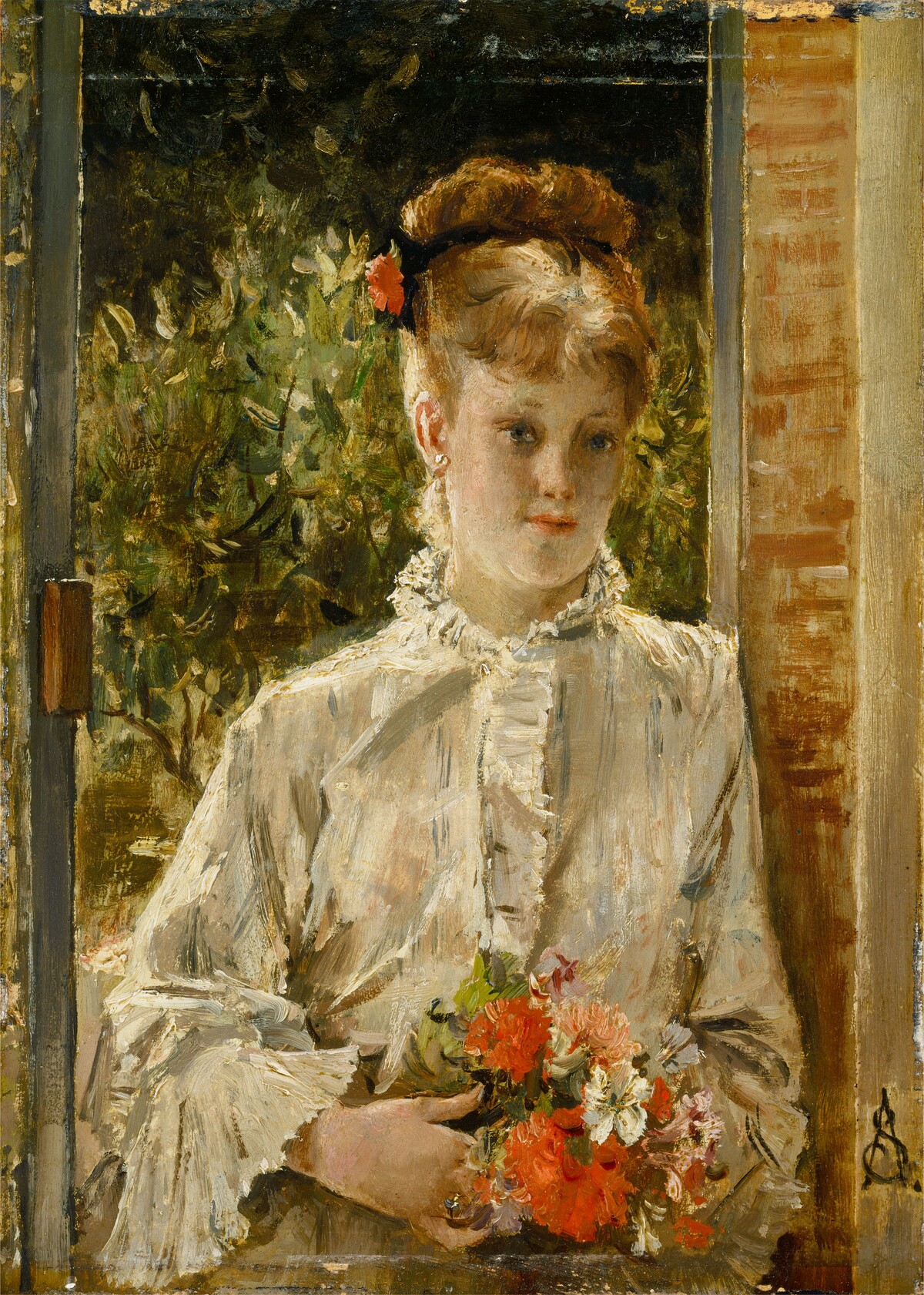
Alfred Stevens's "Young Woman in White Holding a Bouquet" (c. 1865/1875) exemplifies the elegant society portraiture at which this Belgian-born painter excelled. The painting depicts a fashionably dressed woman in white — her sumptuous gown rendered with Stevens's characteristic attention to the play of light across silk and lace — holding a bouquet of flowers that echoes the colors and textures of her clothing. It is a painting concerned above all with surfaces: the sheen of fabric, the softness of skin, the delicate structure of flower petals, and the carefully composed atmosphere of bourgeois domestic comfort.
Stevens (1823–1906) was one of the most successful painters of the Second Empire and Belle Époque, the peer and friend of Manet, Degas, and other Impressionists, yet a painter who chose to remain within the academic tradition rather than join their revolutionary movement. Born in Brussels, he moved to Paris in the 1840s and quickly established himself as the preeminent painter of elegant Parisian women. His canvases showing fashionable women in luxurious interiors — reading letters, playing with pets, gazing from windows — found an eager market among the wealthy bourgeoisie who recognized themselves in his work and appreciated its combination of beauty and social precision.
The painting's small format (oil on wood panel) suggests it was intended as an intimate cabinet picture rather than a large-scale Salon exhibition piece. Stevens was a master of both scales, producing monumental canvases for official exhibition and smaller, more personal works for discerning private collectors. The young woman's white dress — with its elaborate ruching, lace trim, and carefully arranged folds — demonstrates Stevens's deep understanding of contemporary fashion, which was a major selling point of his work. His female subjects are never generic beauties; they are specific women of their era, dressed in identifiable fashions, furnished with recognizable objects in realistically rendered settings.
Stevens's relationship with the Impressionists was complex. He exhibited alongside them on occasion and admired their color sense, but he never abandoned the smooth finish, precise drawing, and narrative content that academic painting demanded. In "Young Woman in White," the influence of Impressionism is visible in the brightness of the palette and the loose handling of the flowers, but the overall effect remains one of polished sophistication rather than perceptual revolution.
Cultural Impact
Stevens's paintings of elegant women defined the visual image of Belle Époque femininity and influenced the development of fashion illustration, interior design representation, and the ongoing tradition of society portraiture.
Why It Matters
This painting captures Stevens's dual achievement — the academic painter's technical mastery combined with a genuine sensitivity to modern female experience, creating images of women that simultaneously embody fashion ideals and individual personality.