Provenance
The sitter [killed during the Spanish Civil War, 1936-1939]; passed at his death to his widow Señora Mañach, Barcelona. (Pierre Matisse Gallery, New York), by 6 June 1952;[1] sold 24 April 1954 to Chester Dale [1883-1962], New York; bequest 1963 to NGA.
[1] Letter of 6 June 1952 from Pierre Matisse to R. Sturgis Ingersoll, in NGA curatorial files, refers to "The painting [_Pedro Mañach_]...which I have discovered and brought to light very recently."
Accession Number
1963.10.53
Medium
oil on canvas
Dimensions
overall: 105.5 x 70.2 cm (41 9/16 x 27 5/8 in.) | framed: 134.6 x 98.7 x 10.2 cm (53 x 38 7/8 x 4 in.) | gross weight: 16.329 kg (36 lb.)
Classification
Painting
Credit Line
Chester Dale Collection
Tags
Painting Early Modern (1901–1950) Oil Painting Canvas Spanish
Background & Context
Background Story
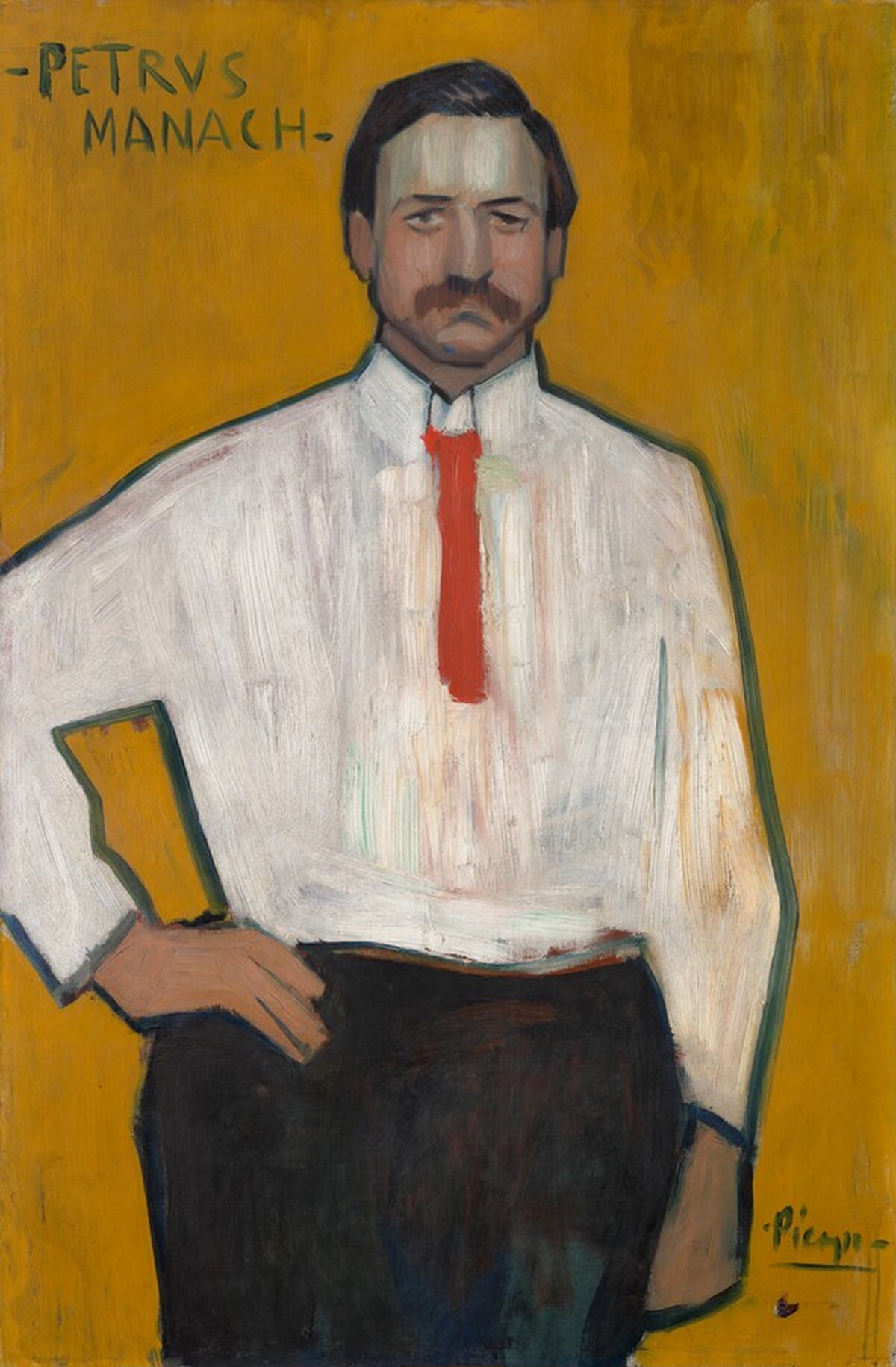
Pedro Mañach (1901) is a portrait of one of Picasso's earliest and most important Parisian patrons. Pedro Mañach, a Catalán anarchist and art dealer, was among the first to recognize Picasso's talent and to provide the financial support that allowed the young artist to survive in Paris. Mañach's portrait—painted during Picasso's first full year in Paris—captures the dealer's energy and intelligence with the directness of an artist painting someone he knew well. The year 1901 was crucial for Picasso: he had arrived in Paris with limited resources and was building the network of dealers, collectors, and fellow artists that would sustain his career. Mañach's support—financial, social, and emotional—was essential to Picasso's survival during this vulnerable period. The portrait's style—transitional between Picasso's academic training and the Blue Period—captures the artist at a moment of change. Mañach's features are rendered with the specificity of a portrait from life, but the painting's emerging expressive tendencies—the elongated form, the simplified features, the emotional intensity—point toward the style that would define Picasso's most important work. The portrait also demonstrates Picasso's ability to capture his sitters' psychological presence—the quality that would make him one of the greatest portraitists of the 20th century.
Cultural Impact
Picasso's early Parisian portraits influenced how the artist's development was understood, documenting the relationships that sustained his career. The paintings influenced how art dealers and patrons were represented in modern portraiture, establishing a tradition of patron portraits that revealed the social infrastructure supporting artistic innovation. The Mañach portrait specifically influenced how Picasso's early career was reconstructed by historians.
Why It Matters
This painting matters because it documents one of the most important relationships in Picasso's early career—the connection to a dealer who recognized his talent when few others did. The portrait of Pedro Mañach is simultaneously a painting of a specific individual and a document of the social network that made Picasso's career possible.