Provenance
Dr. Alexandre, Paris.[1] Josef Stransky [1885-1936], New York, by 1930;[2] (Wildenstein & Co., Inc., New York); sold November 1936 to Chester Dale [1883-1962], New York; bequest 1963 to NGA.
[1] Ralph Flint, "The Private Collection of Josef Stransky," _Art News_ XXIX no. 33 (16 May 1931): 88.
[2] Stransky lent the painting to The Museum of Modern Art's 1930 exhibition _Painting in Paris from American Collections_.
Accession Number
1963.10.52
Medium
oil on canvas
Dimensions
overall: 92.8 x 68.3 cm (36 9/16 x 26 7/8 in.) | framed: 117.8 x 94 x 10.1 cm (46 3/8 x 37 x 4 in.)
Classification
Painting
Credit Line
Chester Dale Collection
Tags
Painting Early Modern (1901–1950) Oil Painting Canvas Spanish
Background & Context
Background Story
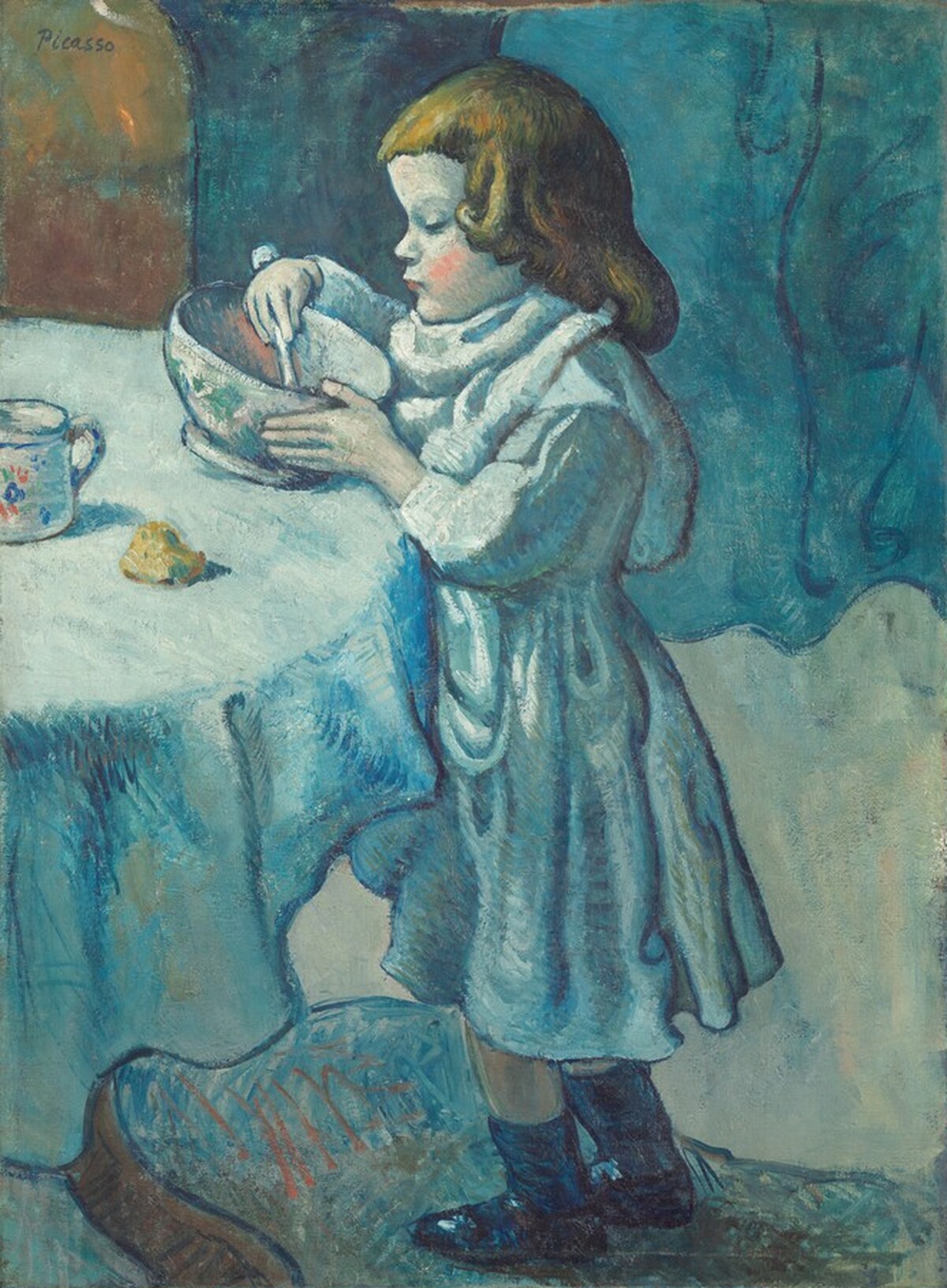
Le gourmet (1901) belongs to Picasso's transition from his early academic style to the Blue Period that would establish his artistic identity. The painting depicts a child or young woman eating—a subject that combines the domestic genre tradition with the emotional intensity that was beginning to characterize Picasso's work. The year 1901 was pivotal: Picasso had arrived in Paris from Barcelona, had witnessed his friend Casagemas's suicide in February, and was channeling his grief and displacement into the elongated forms and blue-dominated palette that would define the Blue Period. Le gourmet's title—the gourmet—suggests an ironic distance between the subject and its treatment: the figure eating is not enjoying gastronomic pleasure but consuming food with the absorption of someone for whom eating is a necessity rather than a pleasure. The painting's palette, moving toward the blues that would dominate Picasso's work for the next three years, captures the melancholy of poverty and isolation that Picasso observed in the marginal neighborhoods of Paris and Barcelona. The painting's date makes it a key document in the development of the Blue Period—the moment when Picasso's personal grief found artistic expression in the chromatic and formal choices that would produce some of the most emotionally powerful paintings of the 20th century.
Cultural Impact
Le gourmet influenced the development of Picasso's Blue Period by establishing the combination of melancholy subject, elongated form, and blue-dominated palette that would define the period's style. The painting influenced how poverty and isolation were represented in modern art, introducing emotional intensity into genre subjects that had traditionally been treated with sentimentality. The painting also influenced how artistic identity was constructed, demonstrating that personal experience could be transformed into artistic style.
Why It Matters
This painting matters because it represents the moment when Picasso stopped being a talented young painter and became a significant artist—the transition from technical skill to emotional expression that the Blue Period crystallized. Le gourmet captures this transition in progress, mixing academic handling with the emerging emotional intensity that would define Picasso's most important early work.