Provenance
Adolph Edward Borie [1809-1880] and his wife, née Elizabeth Dundas McKean, Philadelphia; possibly purchased from Borie or at a sale by George C. Thomas, Philadelphia.[1] (M. Knoedler & Co, London, New York, and Paris), in 1905, and again on consignment in 1910;[2] sold 1910 to R. Horace Gallatin [1871-1948], New York; gift 1949 to NGA.
[1] Lugt lists no Borie sale; the painting was not in the Thomas sale at Samuel Freeman, Philadelphia, 12-13 November 1924.
[2] Knoedler dates confirmed by Robert L. Herbert in a letter dated 15 November 1973 in NGA curatorial files.
Accession Number
1949.1.9
Medium
oil on wood
Dimensions
overall: 18.5 x 24.1 cm (7 5/16 x 9 1/2 in.) | framed: 32.9 x 38.7 x 5.4 cm (12 15/16 x 15 1/4 x 2 1/8 in.)
Classification
Painting
Credit Line
Gift of R. Horace Gallatin
Tags
Painting Neoclassical & Romantic (1751–1850) Oil Painting French
Background & Context
Background Story
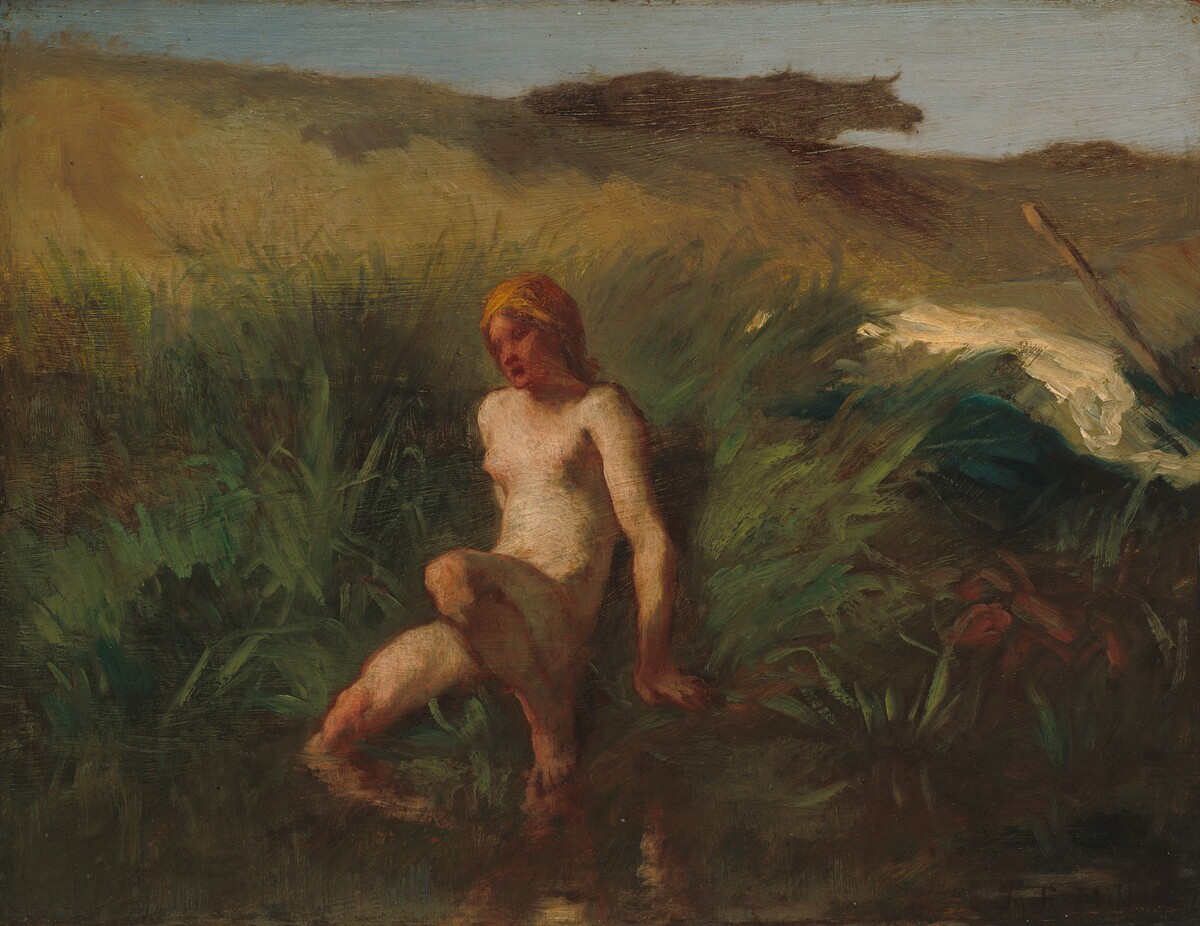
Jean-François Millet (1814-1875) was a French painter known for his images of peasant life that combined Realist observation with a monumental dignity that elevated the rural laborer to the status of a heroic figure. The Bather from 1846-48 is an early work, depicting a nude bather in the landscape with a treatment that shows Millet still working within the academic tradition before the development of the peasant subjects that would make him famous. The 1846-48 date places this before Millet's move to Barbizon and the peasant subjects that defined his mature work, and the wood panel support is characteristic of his early work before he adopted the larger canvases of his Barbizon period.
Cultural Impact
The Bather is important in Millet's development because it shows the academic tradition that he was working within before his move to Barbizon and the development of his peasant subjects. The 1846-48 date makes this a key document in understanding Millet's evolution from academic painter to the Realist painter of peasant life who would become one of the most influential artists of the 19th century. The bather subject shows Millet working within the academic tradition that his later peasant subjects would transform.
Why It Matters
The Bather is Millet before Barbizon: a nude in the landscape rendered within the academic tradition that his peasant subjects would later transform. The 1846-48 painting is a key document in understanding Millet's evolution from academic painter to the Realist painter of peasant life who would influence every subsequent movement in 19th-century art.