Provenance
Thomas Emmerson [d. 1955], London;[1] sold 1830 through (John Smith [1781-1855], London) to George John Vernon, 5th baron Vernon [1803-1866], Sudbury Hall, Derby; possibly (Vernon sale, Christie & Manson, London, 1831); sold to Norton. Brook Greville; (his sale, Christie & Manson, London, 30 April 1836, no. 73); (William Seguier, London).[1] Mary Louisa Whyte [Mrs. Mark Anthony Whyte, d. 1853], Barrow Hill, Rocester, Staffordshire; by inheritance with the house to her niece, Louisa Jane Finch, probably by 1870; by inheritance with the house to her stepson, Captain Arthur Finch Dawson, by 1879; (Dawson sale, Christie, Manson & Woods, London, 14 December 1928, no. 122); (P. & D. Colnaghi & Co., Ltd., London); on consignment or joint account 1931 with (M. Knoedler & Co., London, New York, and Paris). acquired before 1941 by R. Horace Gallatin [1871-1948], New York;[2] gift 1949 to NGA.
[1] See Charles Sebag-Montefiore, with Julia I. Armstrong-Totten, _A Dynasty of Dealers: John Smith and Successors 1801-1824_, The Roxburghe Club, London, 2013: 21.
[2] There was no sale of Vernon paintings at Christie's on 26 May 1831 as indicated by Marcel Roethlisberger, _Claude Lorrain: The Paintings_, 2 vols., New Haven, 1961(reprint 1979), 1:536, no. 281 (citing John Smith, _A Catalogue raisonné of the works of the most eminent Dutch, Flemish, and French painters..._, 9 vols., London, 1829-1842: 8[1837]:446, no. 424). There was a Vernon sale a year later, on 26 May 1832, but the NGA painting was not in it. This painting is probably the _View in a Bay, a Boat in Front_, sold anonymously in 1831 to Norton, as recorded in George Redford, _Art Sales: A History of Sales of Pictures and Other Works of Art_, 2 vols., London, 1888: 2:275. Roethlisberger also incorrectly gives the day of the 1836 Greville sale as April 23, and spells Greville's first name with a final "e" that does not appear on the auction catalogue's title page.
[3] The painting was included in Gallatin's initial offer of his collection to the NGA, which was accepted on an "if and when" basis in 1941; see NGA curatorial files.
Accession Number
1949.1.8
Medium
oil on canvas
Dimensions
overall: 49 x 66.5 cm (19 5/16 x 26 3/16 in.) | framed: 70.5 x 88.3 x 7.6 cm (27 3/4 x 34 3/4 x 3 in.)
Classification
Painting
Credit Line
Gift of R. Horace Gallatin
Tags
Painting Baroque (1600–1750) Oil Painting Canvas
Background & Context
Background Story
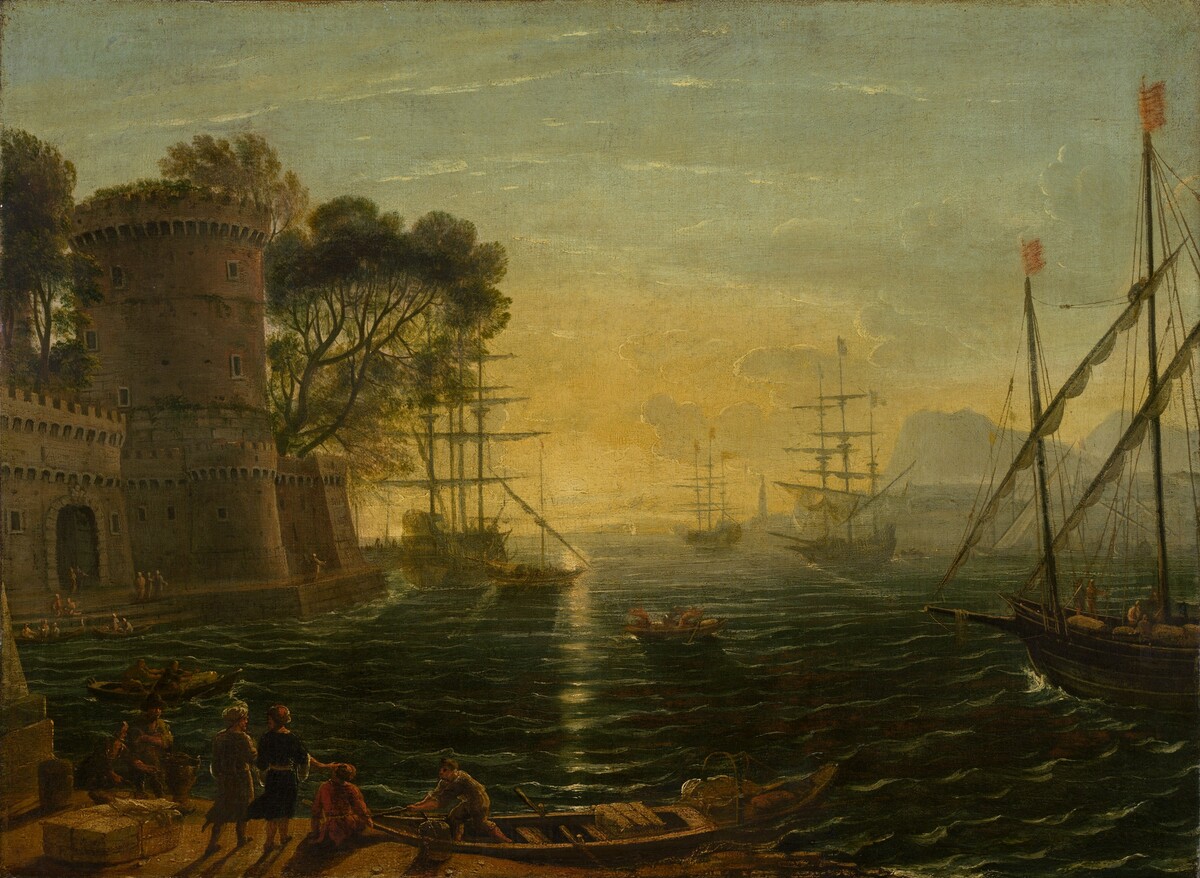
Harbor at Sunset is a painting by a follower of Claude Lorrain, dating to the late seventeenth century. The attribution immediately signals the work's relationship to one of the most influential landscape painters in Western art history. Claude Lorrain (c. 1600-1682) transformed landscape painting from a decorative background into a vehicle for poetic and philosophical expression, pioneering the ideal landscape that combined observed natural effects with an imagined, perfected vision of nature. The harbor at sunset was one of Claude's signature subjects, allowing him to demonstrate his unparalleled ability to render atmospheric light effects—particularly the warm, horizontally cast light of the setting sun that illuminated his compositions from behind their architectural frameworks. A "follower of Claude" operated within the painter's enormously influential legacy, which by the late seventeenth century had already inspired a school of imitators and admirers across Europe. Claude's compositions were so prized and so distinctive that they spawned an entire genre of Claude-inspired harbor scenes, seaports, and pastoral landscapes. These works were not merely copies but creative interpretations of Claude's compositional principles: the framing trees or architecture on either side, the receding perspective toward a luminous horizon, the carefully placed figures providing scale and narrative interest, and above all the treatment of light as the primary subject of the painting. The late seventeenth century saw Claude's influence at its most pervasive. His paintings were avidly collected by the European aristocracy, his drawings were studied by artists across the continent, and his compositional formulas were adapted by painters as diverse as the Dutch Italianates, the English landscape tradition, and the French academic painters who followed. A harbor scene from this period, even by a follower rather than the master himself, participated in a visual language that had become the lingua franca of European landscape art, signaling refinement, classical learning, and poetic sensibility.
Cultural Impact
Claude Lorrain's influence on landscape painting is incalculable, establishing conventions that shaped European and American landscape art for over two centuries. Works by his followers disseminated his visual language far beyond the relatively small number of his own paintings, making the Claudean harbor scene one of the most recognizable subjects in Western art and defining how generations of viewers understood the relationship between ideal beauty and natural observation.
Why It Matters
This painting matters as evidence of the enormous influence Claude Lorrain exercised over late seventeenth-century landscape painting and the creative ways in which his followers adapted his compositional principles to create works that satisfied the period's demand for poetic, light-filled landscapes.