Provenance
(Wallis & Son, London), 1910; purchased by Sir Edgar Vincent, bt., later 1st viscount d'Abernon [1857-1941], Esher and Stoke d'Abernon, Surrey; sold c. 1917 to (Duveen Brothers, Inc., London, New York, and Paris);[1] purchased 1919 by Mr. [d. 1933] and Mrs. Charles H. Sabin, Southampton, Long Island, New York; Mrs. Sabin [née Pauline Morton], who married Dwight F. Davis, Washington, D.C., in 1936; gift 1948 to NGA.
[1] Duveen Brothers to Mrs. John Shapley, 5 August 1948, in NGA curatorial files.
Accession Number
1948.19.1
Medium
oil on canvas
Dimensions
overall: 167.2 x 132.8 cm (65 13/16 x 52 5/16 in.) | framed: 195.9 x 160 x 11.4 cm (77 1/8 x 63 x 4 1/2 in.)
Classification
Painting
Credit Line
Gift of Pauline Sabin Davis
Tags
Painting Neoclassical & Romantic (1751–1850) Oil Painting Canvas Scottish
Background & Context
Background Story
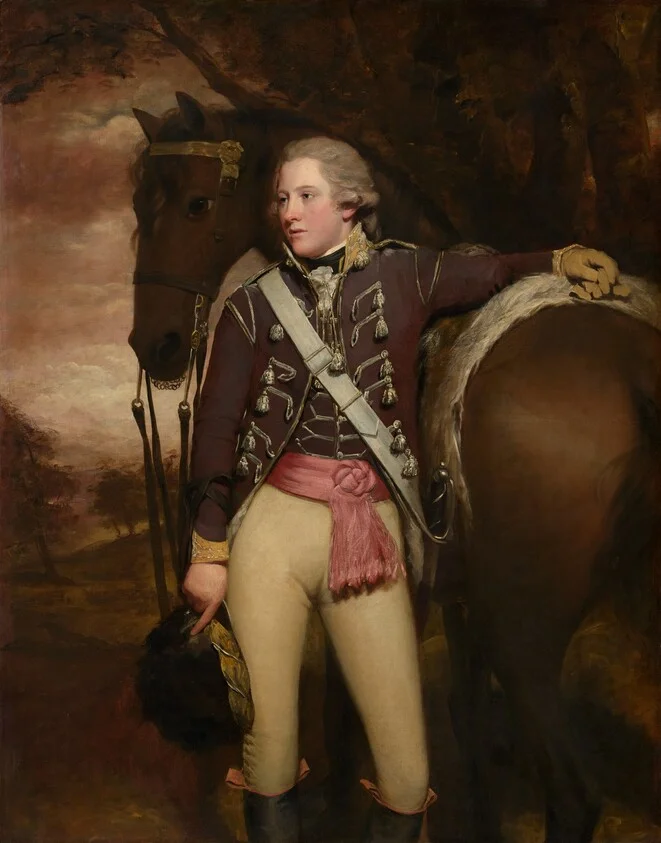
Captain Patrick Miller is one of Raeburn's most dynamic male portraits, depicting a naval officer in the vigorous pose that distinguishes his best male portraiture. The 1788-89 date places this in Raeburn's early maturity, when he was establishing his reputation as Edinburgh's leading portrait painter. Miller's pose—alert, confident, and slightly informal—communicates both the military bearing of a naval officer and the personal vigor that Raeburn captured in his best sitters. The subsequent alterations to the painting suggest that either the sitter or a later owner was not satisfied with some aspect of the original composition and had it modified.
Cultural Impact
Raeburn's military portraits are among his most effective because the officer class provided sitters whose self-presentation already had the vigor and directness that Raeburn was looking for. Captain Miller's military bearing gave Raeburn the pose he needed, and his honest observation gave the portrait the characterization that made it more than a simple record of a uniform. The subsequent alterations to the painting demonstrate that portraits in Raeburn's time were living documents that could be modified to suit changing tastes or family requirements.
Why It Matters
Captain Patrick Miller is Raeburn's military portraiture at its most vigorous: an officer's portrait that captures both military bearing and personal character, without the flattery or idealization that weaker portraitists would have applied. The later alterations show that the portrait was a living document, modified to suit the needs of its owners.