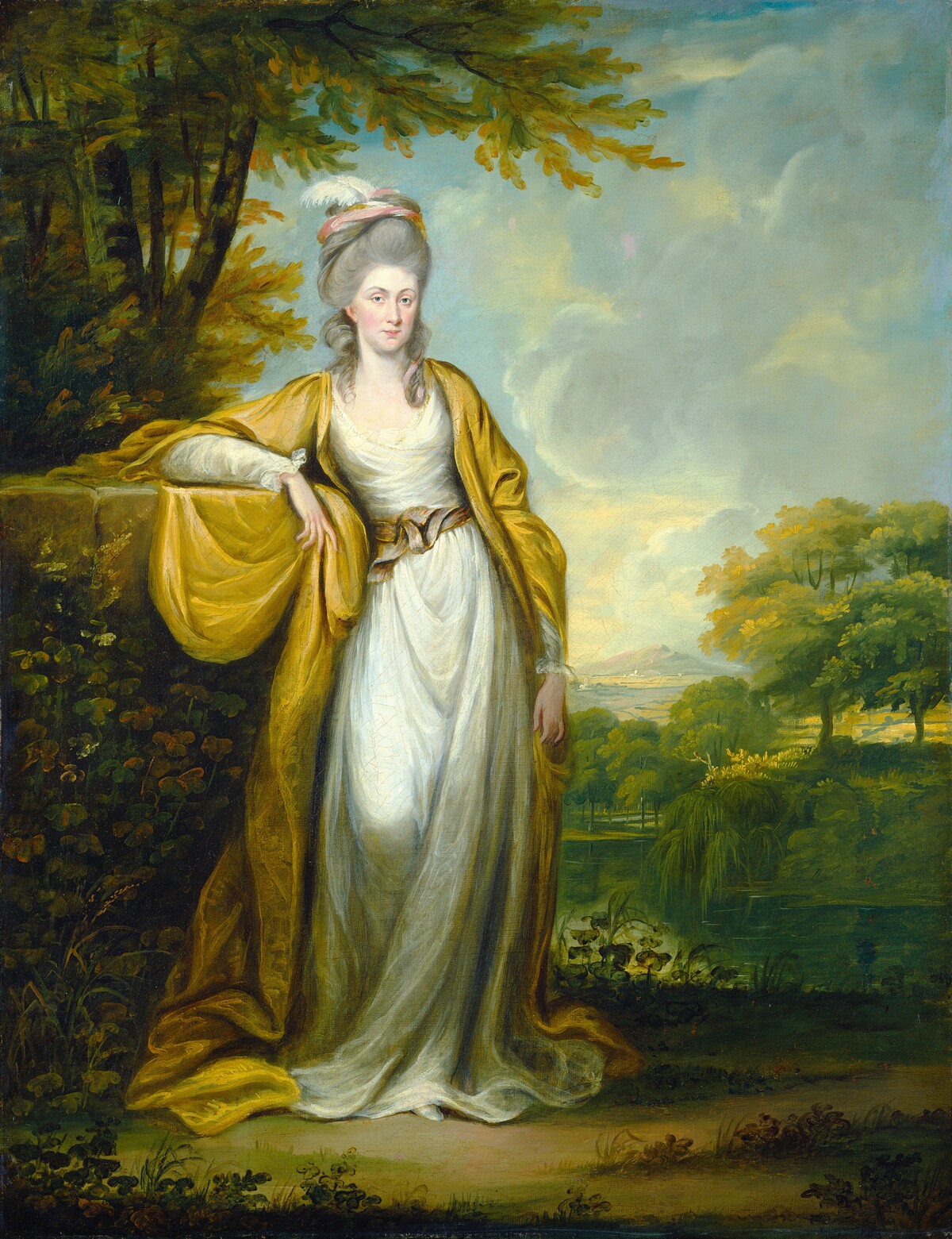
Provenance
E. Ledger; (Arthur Tooth & Sons), London, 1923; who sold it 10 April 1924 to (Thos. Agnew & Sons), London, as by Sir Martin Archer Shee; purchased from Agnew's by Howard Sturges [d. 1955], Providence, Rhode Island; by bequest to NGA, 1956.
Accession Number
1956.9.5
Medium
oil on canvas
Dimensions
overall: 91.5 x 71.5 cm (36 x 28 1/8 in.) | framed: 107.3 x 87 x 4.1 cm (42 1/4 x 34 1/4 x 1 5/8 in.)
Classification
Painting
Credit Line
Gift of Howard Sturges
Tags
Painting Neoclassical & Romantic (1751–1850) Oil Painting Canvas British
Background & Context
Background Story
Lady Algernon Percy is a portrait by James Millar dating to approximately 1777-1780, depicting a member of the prominent Percy family, one of the most powerful aristocratic dynasties in British history. The Percy family, holders of the earldom and later dukedom of Northumberland, wielded enormous influence in British political and social life, and portraits of their family members served important functions in asserting status and cementing alliances. Lady Algernon Percy would have been painted at a moment when aristocratic portraiture was undergoing significant changes in Britain. The grand manner established by Sir Joshua Reynolds and Thomas Gainsborough had come to define how the British elite wished to be seen—graceful, confident, and surrounded by attributes of their social position. James Millar, while not as celebrated as Reynolds or Gainsborough, operated within this same tradition of fashionable portraiture, producing likenesses that satisfied his patrons' desire for images that combined recognizable features with the dignity and elegance appropriate to their rank. The late 1770s were a period of social turbulence in Britain, with the American War of Independence challenging British imperial confidence and the beginnings of industrial transformation reshaping the economy. In this context, aristocratic portraiture served as a visual assertion of continuity and stability, presenting the established order as natural and enduring. The Percy family, whose roots extended back to the medieval period, were particularly invested in this visual language of permanence and authority.
Cultural Impact
Aristocratic portraits of this period functioned as both personal records and political statements, reinforcing the social hierarchy through visual conventions that communicated birth, wealth, and authority. The sheer volume of such portraits created a visual vocabulary of power that extended well beyond the actual sitters, shaping how the British class system represented itself to itself and to the wider world.
Why It Matters
This portrait matters as a document of late eighteenth-century British aristocratic culture and the visual strategies through which one of England's most powerful families projected its status during a period of social transformation.
![Saint Bernard and Saint Catherine of Alexandria with the Virgin of the Annunciation [right panel]](https://api.nga.gov/iiif/e6890364-4d99-4684-a62b-5060ee3c3446/full/400,/0/default.jpg)