Provenance
Traditionally said to have belonged to Odette-Marie de Montesquiou-Fezensac [1853-1874], wife of comte Antoine de Gramont d'Aster [1846-1894]; presumably by inheritance to her brother, Louis-Paul-Anatole, marquis de Montesquiou-Fezensac [1857-1883]; by inheritance to his widow [née Claude-Étiennette-Marie-Octavie de Sauvan d'Aramon, 1864-1936];[1] (Wildenstein & Co., Paris, New York, and London); sold December 1944 to the Samuel H. Kress Foundation, New York;[2] gift 1946 to NGA.
[1] The provenance provided by Wildenstein to the Kress Foundation also includes the name of the comtesse Fleury, with no additional information. The picture was not included in any known Gramont or Fleury sales; see Colin Eisler, _Paintings from the Samuel H. Kress Foundation: European Schools Excluding Italian_, Oxford, 1977: 311 nn 7 and 8.
[2] The memorandum of agreement between Wildenstein & Co. and the Samuel H. Kress Foundation for the sale of ten paintings, including _Mme. de Caumartin_ by Jean Marc Nattier, is dated 28 December 1944 (copy in NGA curatorial files).
[2] The Gramont, Fleury, and Montesquiou names also appear in the provenance provided by Wildenstein; see letter dated 14 April 1999 in NGA curatorial files. See also The Kress Collection Digital Archive, https://kress.nga.gov/Detail/objects/1315.
Accession Number
1946.7.13
Medium
oil on canvas
Dimensions
overall: 102.5 x 81.5 cm (40 3/8 x 32 1/16 in.) | framed: 126.4 x 106.7 x 13 cm (49 3/4 x 42 x 5 1/8 in.)
Classification
Painting
Credit Line
Samuel H. Kress Collection
Tags
Painting Neoclassical & Romantic (1751–1850) Oil Painting Canvas French
Background & Context
Background Story
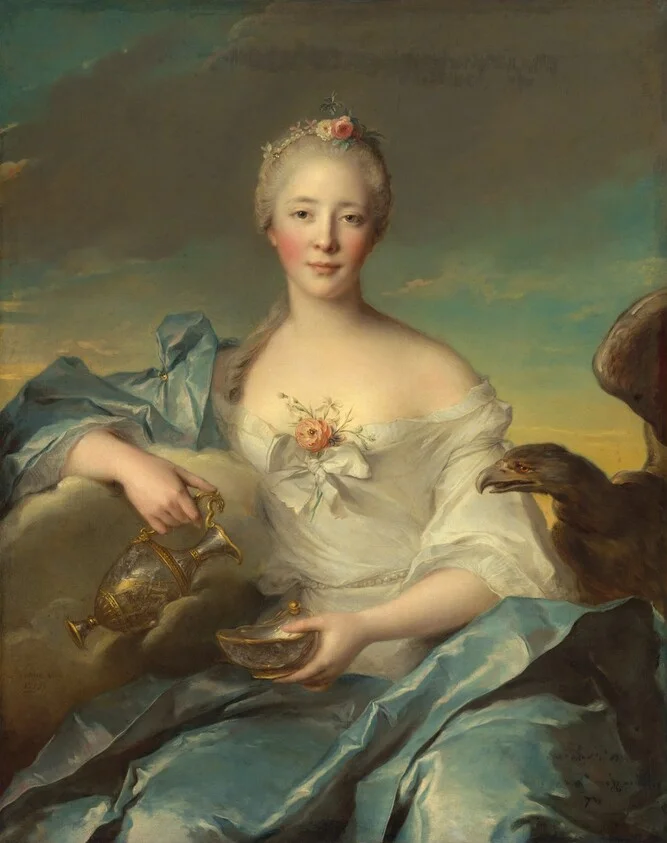
Jean-Marc Nattier (1685-1766) was a French portrait painter known for his portraits of the ladies of the court of Louis XV in the guise of mythological figures—Rome, Diana, Hebe—that combine the official manner of court portraiture with the Rococo taste for mythological disguise. Madame Le Fevre de Caumartin as Hebe from 1753 depicts the sitter as Hebe, the cupbearer of the gods, in the elegant, flattering manner that distinguishes Nattier's mythological portraits. The 1753 date places this in Nattier's most productive period, when he was producing the mythological portraits that are among the most characteristic works of the French Rococo.
Cultural Impact
Madame Le Fevre de Caumartin as Hebe is important in the history of French Rococo portraiture because it demonstrates the mythological portrait that Nattier invented—the disguise of court ladies as mythological figures that combined the official manner of court portraiture with the Rococo taste for mythological fancy dress. The portrait of Mme Le Fevre de Caumartin as Hebe shows Nattier's formula at its most accomplished, combining official portrait dignity with the lightness and charm of Rococo mythology.
Why It Matters
Madame Le Fevre de Caumartin as Hebe is Nattier's mythological portrait at its most characteristic: a court lady depicted as the cupbearer of the gods in the elegant, flattering combination of official portraiture and Rococo mythology that Nattier invented. The 1753 painting is among the most characteristic works of the French Rococo.