Provenance
Jean-Joseph-Pierre-Augustin Lapeyrière [1779-1831, known as Augustin Lapeyrière, then Augustin de Lapeyrière]; (his sale, Henry at Galerie Le Brun, Paris, 19 April 1825 and days following [originally scheduled for 14 March and days following], no. 72).[1] Chevalier Sébastien Érard [1752-1831], Château de la Muette, near the Bois de Boulogne, Paris; (his estate sale, at his residence by Lacoste and Coutelier, 7-14 August 1832 [originally scheduled for 23 April and days following], no. 183);[2] bought by Dougas. William Williams Hope [1802-1855], Rushton Hall, Northamptonshire, and Paris; (his estate sale, Hôtel Drouot, Paris, 11 May 1858, no. 1); bought for Baron James de Rothschild [1792-1868]; his son, Baron Gustave Salomon de Rothschild [1829-1911]; his daughter Aline de Rothschild Sassoon [1865-1909]; her husband Sir Edward Sassoon [1856-1912]; their daughter, Sybil Sassoon [1894-1989, who married in 1913 George Horatio Charles, 5th marquess of Cholmondeley], Houghton Hall, Norfolk; sold 1939 to (Wildenstein & Co., Paris, New York, and London);[3] sold 1945 to the Samuel H. Kress Foundation, New York;[4] gift 1946 to NGA.
[1] Lapeyrière is identified on the title page of the sale catalogue as "receveur general des contributions du Département de la Seine." An annotation in the NGA Library's copy appears to give a buyer's name that is not entirely legible: "Const. . ."
[2] This sale was incorrectly published in the NGA systematic catalogue as being held in 1831, and originally scheduled only for April 23 (Conisbee, Philip, et al. _French Paintings of the Fifteenth through the Eighteenth Century_. The Collections of the National Gallery of Art Systematic Catalogue. Washington, D.C., 2009: no. 22, 109).
[3] See Lady Sybil Cholmondeley, letters to John Walker, 11 October 1965 and 3 February 1969, in NGA curatorial files.
[4] See The Kress Collection Digital Archive, https://kress.nga.gov/Detail/objects/2190.
Accession Number
1946.7.12
Medium
oil on canvas
Dimensions
overall: 120.7 x 160 cm (47 1/2 x 63 in.) | framed: 161.3 x 200 cm (63 1/2 x 78 3/4 in.)
Classification
Painting
Credit Line
Samuel H. Kress Collection
Tags
Painting Baroque (1600–1750) Oil Painting Canvas
Background & Context
Background Story
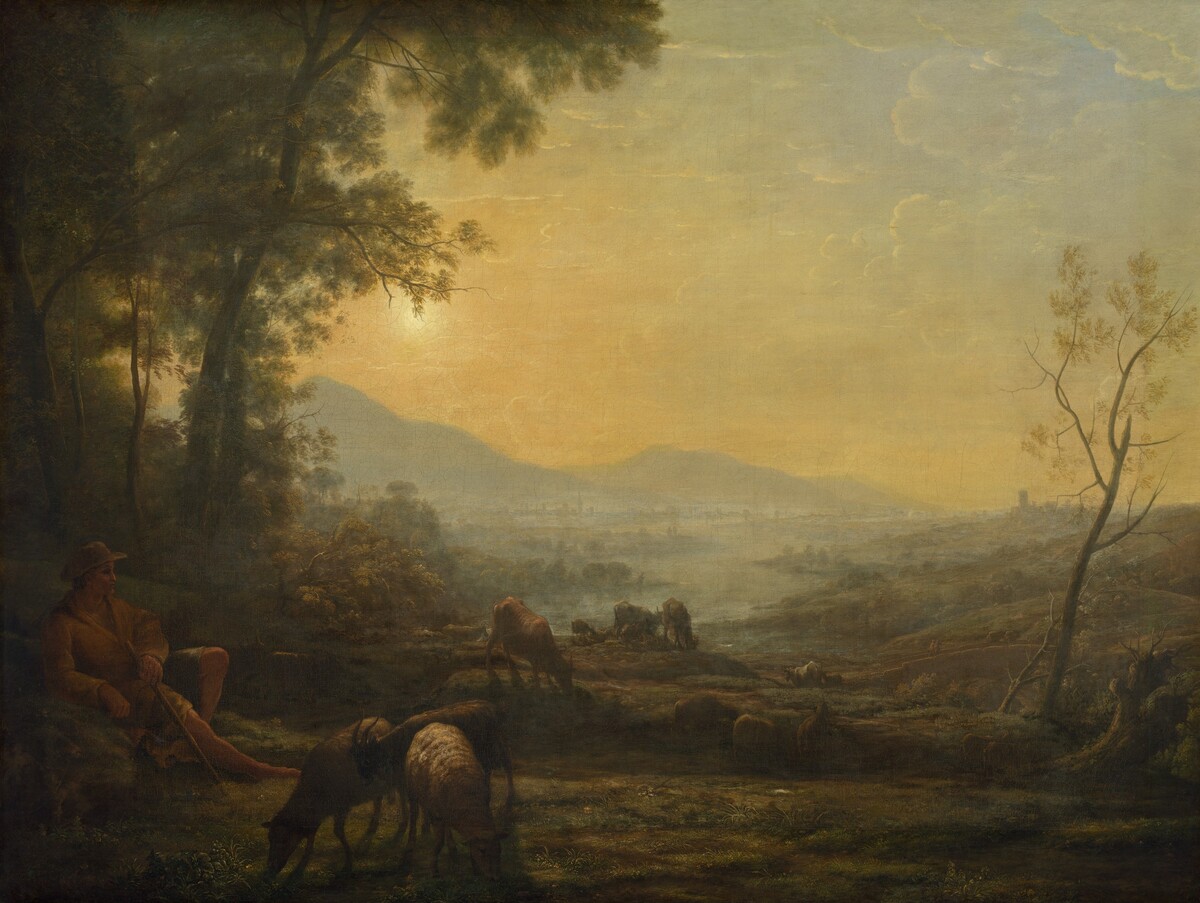
This painting of a herdsman is attributed to a Follower of Claude Lorrain (1600-1682), the French painter known for the luminous, idealized landscapes that make him one of the most important landscape painters in the history of art. The herdsman subject is typical of Claude's pastoral landscapes, which depict idealized shepherds and herdsmen in luminous, classically composed settings. The 17th or 18th century date places this in the period when Claude's influence on European landscape painting was at its height, and the follower's version demonstrates how Claude's luminous, idealized manner was adopted and adapted by followers who helped spread his influence throughout Europe.
Cultural Impact
The Herdsman is important in the history of European landscape painting because it demonstrates how Claude Lorrain's luminous, idealized manner was adopted by followers who helped spread his influence throughout Europe. Claude's luminous, classically composed landscapes were the most influential landscape paintings in European art for over two centuries, and the 17th or 18th century painting shows how this influence was adopted and adapted by followers throughout Europe.
Why It Matters
The Herdsman by a Follower of Claude Lorrain: a pastoral scene rendered in the luminous, idealized manner of the most influential landscape painter in the history of European art. The 17th or 18th century painting shows how Claude's luminous, classically composed manner was adopted by followers who spread his influence throughout Europe.