Provenance
Possibly William Williams Hope [1802-1855], Rushton Hall, Northamptonshire, and Paris; possibly by gift to Madame Jenny Colon [1808-1842], Paris.[1] Emile [1800-1875] and Isaac [1806-1880] Péreire, Paris, by 1864; (Péreire sale, at their residence by Pillet and Petit, Paris, 6-9 March 1872, no. 61); Frédéric-Alexis-Louis Pillet-Will, comte Pillet [1837-1911], Paris, until at least 1910.[2] (Wildenstein & Co., Inc., Paris, New York, and London), by 1932;[3] Calouste Gulbenkian [1869-1955]; (Wildenstein & Co., Inc., Paris, New York, and London);[4] sold 1942 to the Samuel H. Kress Foundation, New York;[5] gift 1946 to NGA.
[1] For the Hope-Colon provenance, see W. Bürger, "Galerie de MM. Pereire," _Gazette des Beaux-Arts_ ser. I, 16 (April 1864): 201.
[2] The painting was lent by Pillet-Will to an exhibition in Berlin in 1910.
[3] The painting was lent by Wildenstein to a 1932 exhibition in London.
[4] Georges Wildenstein's letter of 21 January 1952 to John Walker (NGA curatorial files) confirms Gulbenkian's ownership and the fact "that my father bought [it] back from him."
[5] See also The Kress Collection Digital Archive, https://kress.nga.gov/Detail/objects/40.
Accession Number
1946.7.5
Medium
oil on canvas
Dimensions
overall: 115 x 87.5 cm (45 1/4 x 34 7/16 in.) | framed: 145.1 x 116.8 x 12.1 cm (57 1/8 x 46 x 4 3/4 in.)
Classification
Painting
Credit Line
Samuel H. Kress Collection
Tags
Painting Neoclassical & Romantic (1751–1850) Oil Painting Canvas French
Background & Context
Background Story
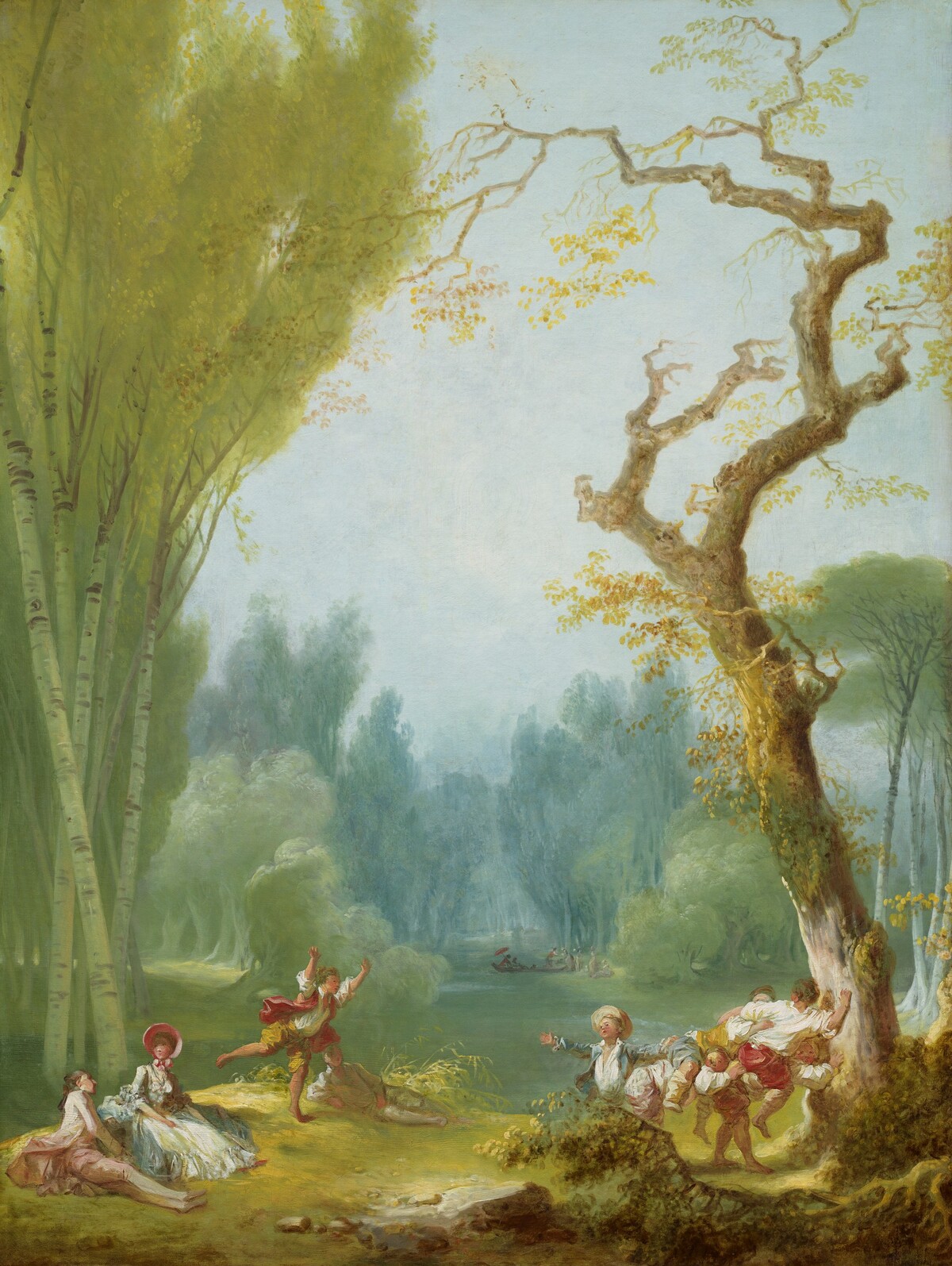
A Game of Horse and Rider (c. 1770-1775) belongs to Fragonard's series of fête galante paintings depicting the garden games that were the signature social rituals of the French aristocracy before the Revolution. The game of horse and rider—a playful variation of the riding hobby in which one partner pretends to be the horse and the other the rider—was one of the many garden amusements that allowed aristocratic society to combine physical play with flirtation. Fragonard's treatment of the game captures the physical comedy that garden games facilitated: the pretense of horse and rider, the inversion of social roles that the game enacted, and the specific quality of aristocratic leisure that found amusement in such playful transformations. The 1770-75 date places this during Fragonard's most productive period, when he was painting the fête galante subjects that would define the Rococo's visual legacy. His handling—the rapid brushwork, the warm palette, and the compositional energy that distinguishes his best work—gives the game a visual excitement that matches the players' amusement. The garden setting, with its formal layout and its associations with aristocratic leisure, provides the context that gives the game its social meaning. The painting also documents the specific culture of aristocratic amusement before the Revolution—the games, the flirtations, and the refined pleasure that would be swept away by the events of 1789.
Cultural Impact
Fragonard's garden-game paintings influenced how aristocratic play was represented in 18th-century art, establishing the garden game as a significant Rococo subject. The paintings influenced later French artists who similarly found subjects in the interplay of play and social meaning. The Horse and Rider game influenced how the relationship between amusement and social structure was represented in visual art.
Why It Matters
This painting matters because it captures the specific quality of aristocratic amusement before the Revolution—the garden games that combined physical play with social flirtation and that defined the leisure culture that the Revolution would destroy. Fragonard's rapid handling and compositional energy preserve this vanishing world with a vivacity that more formal documentation could not achieve.